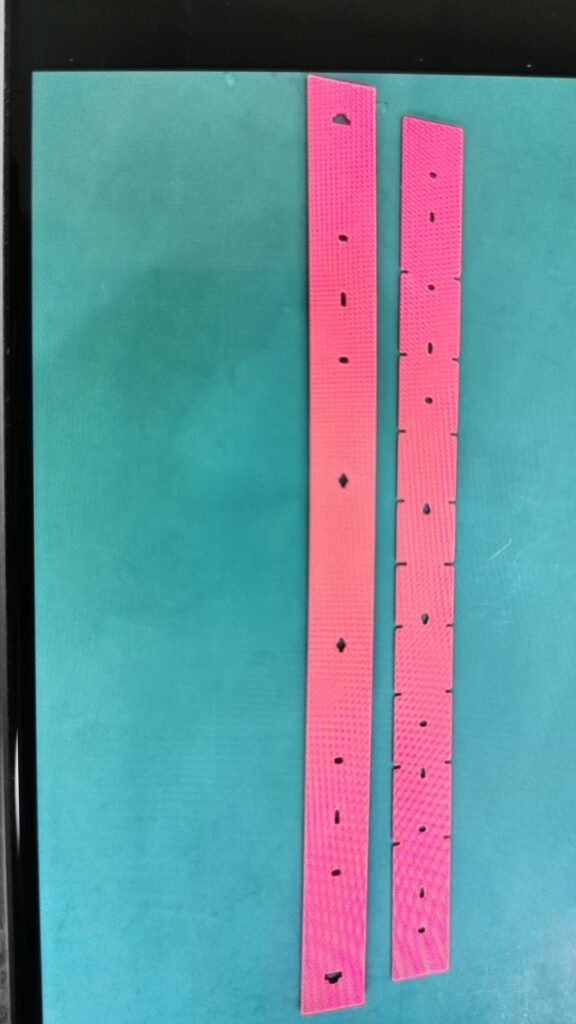
Aftermarket replacement part — not a genuine OEM part. The squeegee blades and rubber parts on this page are aftermarket replacements made to fit Nilfisk machines. They are not genuine Nilfisk parts, we are not affiliated with or endorsed by Nilfisk, and brand names, model names and part numbers are used for fitment reference only. Confirm dimensions against your own sample or drawing before ordering.
The most expensive failure in a squeegee blade happens before the blade is ever fitted. Wholesale buyers meet it more often than end users, because the minimum order that makes the price work also creates a shelf. A box stored for months in a warm loading bay can arrive with a lip already hardened, and no amount of down-pressure will make it seal. This page treats the Nilfisk BA 531 as a stocked replacement part: confirming fitment, choosing the grade, writing the order so stock stays usable, and the terms that let one shipment test two compounds.
The badge identifies the machine, not the blade in the box
A model name is a search term. It tells you the machine family, not which blade is fitted today. The Nilfisk professional site helps confirm the family and configurations offered, but it is an identification aid, not a parts list, and it will not tell you which compound suits your floor. We do not publish dimensions, OEM part numbers or DIN abrasion values we cannot confirm; where a number is missing, confirm it against your own sample or drawing and check with us before ordering.
Start with the profiles we already tool. Our cross-reference guide is a starting point to check against the worn blade, not a promise that a badge maps to one profile — a frame revised in service counts as a new one. Note whether the assembly is straight or curved and photograph it from above with the blade in place: a straight blade forced into a curve lifts at both ends.
Read the old blade first. A blade that lifts at an end is geometry, and no rubber change seats it. One that chatters on polished tile is a compound problem, and extra down-pressure makes it worse. One that swells, goes tacky or cracks is chemistry or temperature; changing the grade without changing the detergent buys the same failure again.
Why a wholesale order creates a storage problem
MOQ is 20 sets per style on a profile we already tool. A new style carries USD 60–120 tooling, waived once cumulative volume reaches 500 sets, and volume counts across reorders. Mixed orders are allowed with a USD 3,000 minimum order value, so one shipment can carry a 20-set trial of natural rubber alongside a small polyurethane lot for the rough-floor machines on the same route instead of two freight bills and two customs entries. Consolidating styles into fewer, larger orders is standard in the cleaning channel, and ISSA material helps make that case internally.
Consolidation has a consequence that rarely appears in a quotation: 20 sets is far more than one machine consumes in a single replacement cycle, so most of the order goes into storage. Rubber does not stop changing when the carton is closed. Three things in an ordinary store do the damage.
Heat and sunlight. A bay beside a boiler room, a roller door in direct sun or a pallet under a roof light runs much warmer than the floor the machine works on. Warmth accelerates oxidation; a lip that has gone hard and glossy will chatter on smooth tile even though the compound was correct when it left us. Keep cartons cool, shaded and dry, off the floor and away from radiators.
Ozone. Battery chargers, motors and anything that sparks produce ozone, which attacks the rubber surface and opens fine cracks across a bent lip. Do not store blades in the charger room or beside running equipment.
Bending and weight. Store strips flat in their cartons. A blade kept curved around a rack or crushed under heavier boxes arrives pre-bent, lifts at the ends, and no down-pressure seats it — geometry, not a compound fault.
Polyurethane is more sensitive to temperature and operating conditions than natural rubber, so a mixed pallet containing both grades should not be stored as if every box were identical. Give the polyurethane styles the more controlled shelf and qualify them by site. At goods-in, flex a strip for surface cracks and quarantine any box whose edge has gone glossy, brittle or tacky.
Write storage into the purchase order
The same carton labelling that supports a claim also supports rotation. Ask for cartons marked by style, by half of the set and by production date, then apply first in, first out; put the newest box behind the oldest and do not open a fresh carton while an older one of the same style is still sealed. Write the date of receipt on the box where the storekeeper can see it.
Tie the review to consumption, not the calendar. Our replacement cycle guide turns the two-to-three-month figure into a reorder point; compare that rate with how many sets you hold. If stock is many cycles deep, the next order should be shallower and more mixed rather than another full 20 sets of one style. A wet floor left by a hardened blade is a facilities issue too, and OSHA 1910.22 is the US reference for keeping walking surfaces safe.
Size the first order with us: fleet size, how many machines share the assembly and sets fitted per month tell us whether a 20-set trial in one grade or a split across two leaves less rubber ageing on your shelf. Samples are chargeable, not free, and take 7–15 days to prepare and ship; budget that window before the current set is due.
Three grades, one tolerance
Specify hardness with a tolerance and a named test method, and ask for readings off production pieces rather than a compounder’s coupon: the coupon proves the mixer, the production piece proves the tool. Durometer is measured by ASTM D2240, and ASTM D2000 frames classification and batch-to-batch consistency. All three grades carry a ±5 Shore A tolerance:
- Natural rubber, 65 ± 5 Shore A — the default for most indoor commercial work; conforms well to smooth tile, PVC and sealed epoxy.
- Cast polyurethane, 85 ± 5 Shore A — rough or damaged concrete, expansion joints, oily surfaces and long abrasive shifts; generally lasts longest there, provided the machine can press the lip flat.
- Economy gum rubber, 45 ± 5 Shore A — light duty on smooth floors where price leads and the area is small.
Our material comparison sets out the wear-versus-sealing trade-off; use it to sanity-check a recommendation, not to skip the assembly check. Our red rubber sheet guide explains why colour is pigment rather than performance — compare the compound and test figures instead.
Service life in normal commercial duty is typically two to three months, an industry figure rather than a guarantee; it moves with cleaning frequency, chemicals, temperature and floor condition. A blade that aged in storage will not reach even that figure, which is why the shelf belongs in the specification.
Terms, claims and what a claim covers
Replacement terms are agreed on the order, not after it. The window is 7 days from receipt, counted from the delivery date rather than dispatch; only the defective pieces are replaced, not the whole batch; an unboxing video filmed from before the carton opens is required; and freight on replacement pieces falls to the buyer, usually absorbed into the next shipment. Coverage is for manufacturing defects: damaged edges, wrong dimensions, hardness outside the agreed range. It does not extend to ordinary wear, fitting damage, a compound wrong for the floor, or rubber hardened after months in a hot store — precisely why the storage rule belongs in the specification. Photograph the unopened carton, count front and rear pieces against the purchase order, and lay a delivered blade beside the retained worn set before fitting.
One set is one front blade plus one rear blade: the rear holds the vacuum seal, the front takes the debris and most of the abrasion. An enquiry that says only “BA 531 blades” is often priced as single strips, producing a wrong count and a second order to fix it. State the split in the purchase order. The margin sits in the gap against a captive OEM parts channel, developed in OEM vs aftermarket squeegee blades.
What to send for an accurate quote
Send a worn front and rear blade or clear photos, a view showing whether the assembly is straight or curved, the floor finish, detergent and wash-water temperature, fleet size, monthly set consumption, and your sample ID. Tell us where the cartons will be stored. We will confirm the profile against your sample or drawing, say whether we hold tooling, recommend a grade and quote a 20-set trial with lead time and freight options. Request pricing or a sample set and we will come back with the fitment and the storage rule written down rather than a guess.
A blade that ages on your shelf never gets the chance to wear out on the floor.