The best job in the repair business is the one that books itself.
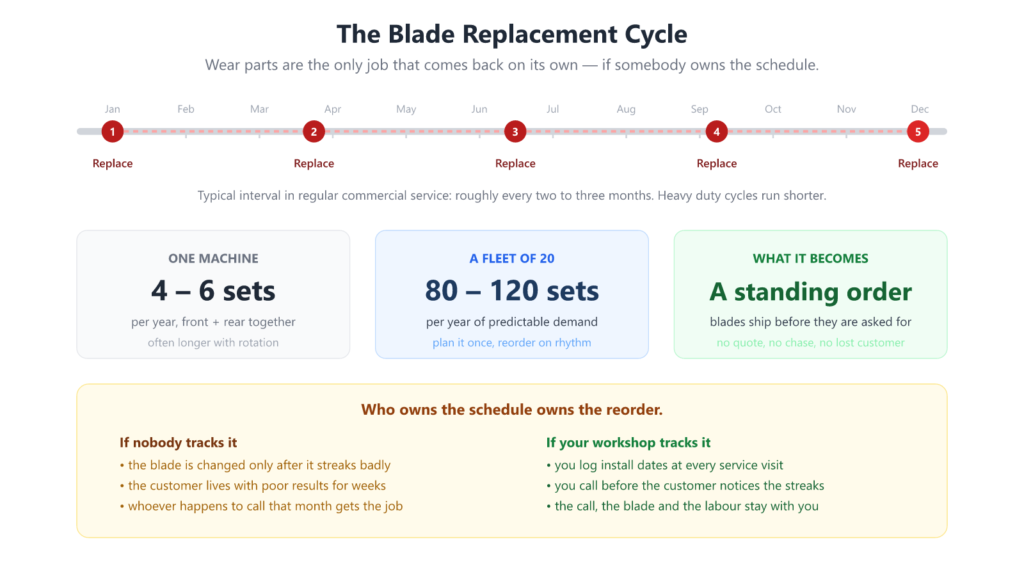
A gearbox fails once. A vacuum motor fails once. A squeegee blade comes back every two to three months, forever, without anyone selling anything. Wear parts are the only revenue in your business that renews itself — if, and only if, somebody owns the schedule.
Most workshops don’t. That is the opportunity.
The cycle, in numbers
In regular commercial service, squeegee blades commonly run two to three months before edge wear starts streaking the floor. Treat that as a typical industry figure, not a guarantee — floor texture, duty cycle, temperature and chemistry all move it. Oily floors are hardest on the wrong material, which we cover in the material comparison.
From one number, everything else follows:
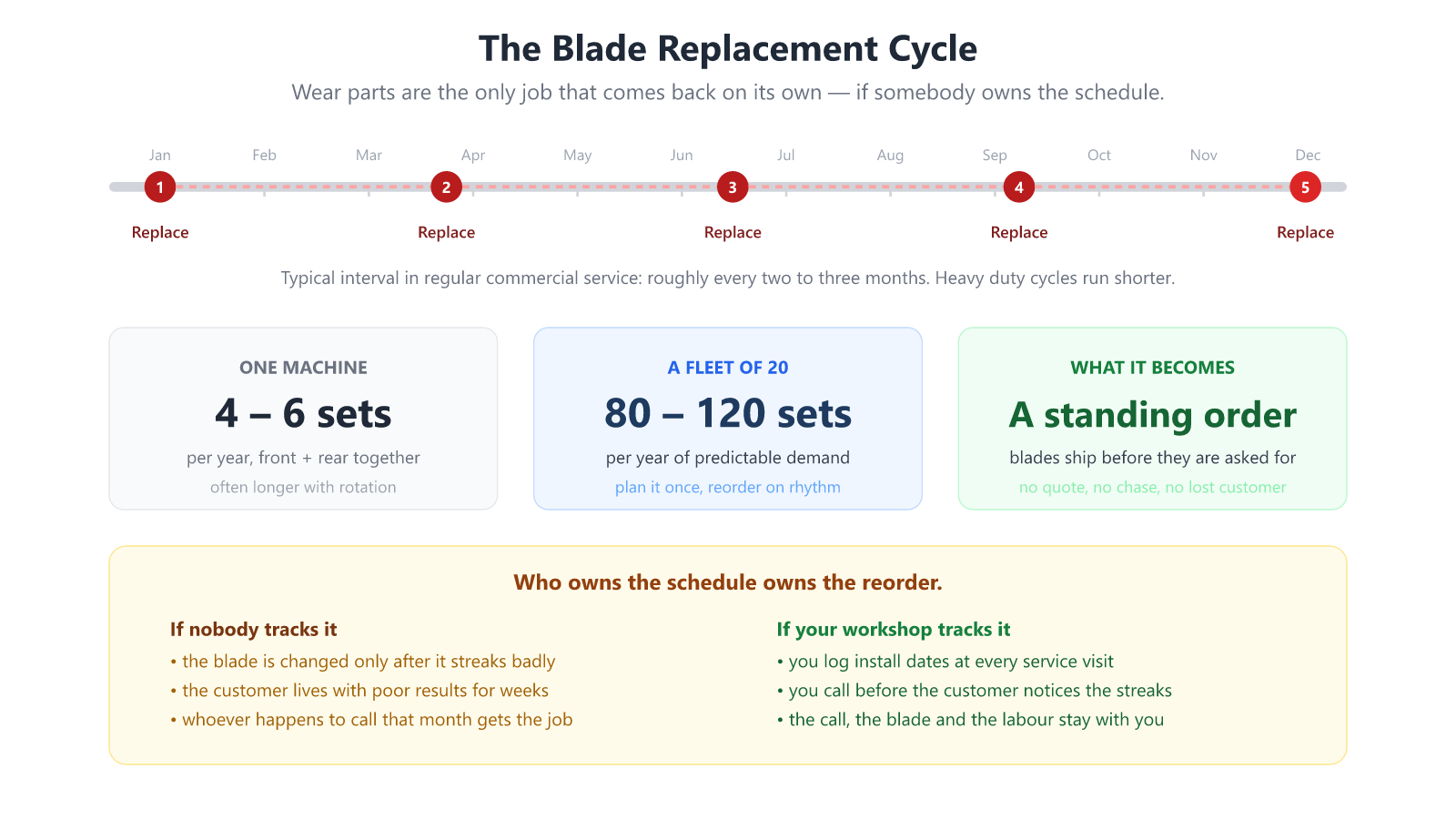
- One machine: 4–6 blade sets per year (front + rear replaced together)
- A fleet of 20 machines: 80–120 sets per year
- A distributor’s service region: thousands of sets, all renewing on a rhythm nobody has to create — only maintain
Compare that with repair work. Every repair job must be won again from zero: the failure happens, the customer shops, you quote. The blade reorder needs no selling at all. It needs a calendar.
Who owns the schedule owns the reorder
Two workshops service the same machine. Both fit the same blade at the same quality.
Workshop A changes blades when the customer complains about streaks. Workshop B logged the install date, and calls in month ten — before the streaks — with: “Your blades are due. Same set as last time, it’ll be with the tech on Thursday.”
Same part. Same price, probably. Completely different business.
Workshop A competes for every order. Workshop B collects them. When blades ship before they are asked for, there is no quote to shop around, no competitor in the inbox, no decision for the customer to make. The call, the blade and the labour stay with whoever owns the schedule.
Three habits that convert wear into revenue
1. Log the install date at every service visit. It takes ten seconds and it is the entire system. Blade set, machine, date.
2. Replace front and rear together, on schedule. The rear blade does most of the drying and wears first; but mixing an old front with a new rear leaves water where the old blade passes. Pairs, always — which is also how we quote: per set, not per piece.
3. Call before the failure, not after it. A reminder call in month ten is service. A callback in month twelve about a wet floor is an apology — and an opening for your competitor who happened to call first.
What to keep in stock to honor the schedule
A standing reorder promise collapses if the part isn’t there. Two ways to guarantee it:
Finished blade sets. Minimum order from us is 20 sets per style, mixed models and brands allowed to a USD 3,000 opening order. For a fleet of twenty machines, that is barely one replenishment cycle of stock — covering 4–6 replacements per machine before you reorder.
Bulk rubber sheet. The sheet approach goes further: one roll covers every machine in the fleet, cut to length at the bench, nothing on the shelf ever becomes obsolete.
Either way, the stock question is small once the schedule exists. The schedule is the asset.
The conversation to have with your customer
Offer it as a line item, not a favour:
“We’ll include scheduled blade replacement on all units — front and rear sets every quarter, fitted and logged. Fixed price per set, invoiced as delivered.”
The customer gets predictable floors and one less thing to manage. You get contracted volume at your margin, and a reason to be on site four to six times a year — where every other wear part on that machine is your upsell.
Wear parts are a subscription in disguise. The machine has been paying you every ninety days all along. It was just waiting for someone to own the calendar.
Plan your fleet’s blade year
Send us your machine list — brands, models, rough counts — and we’ll spec the blade sets, quote the annual volume, and set up the standing replenishment. Minimum trial: 20 sets, mixed models welcome.