Aftermarket replacement parts — not genuine OEM parts. The squeegee blades and rubber parts on this page are aftermarket replacements made to fit the machines named here (Comac, Hako, Kärcher, Nilfisk and others). They are not genuine parts from those manufacturers, we are not affiliated with or endorsed by them, and brand names, model names and part numbers are used for fitment reference only. Confirm dimensions against your own sample or drawing before ordering.
Every parts room has a shelf of blades that will never sell.
A front blade for a machine you serviced once. A rear blade in a length the customer upgraded away from. Each one was correct on the day it arrived. Together they are dead capital — and the shelf space is the smallest of the three costs.
There is a different way to stock squeegee blades, and it starts with a question most suppliers never ask: what actually varies between blades?
The variable and the constant
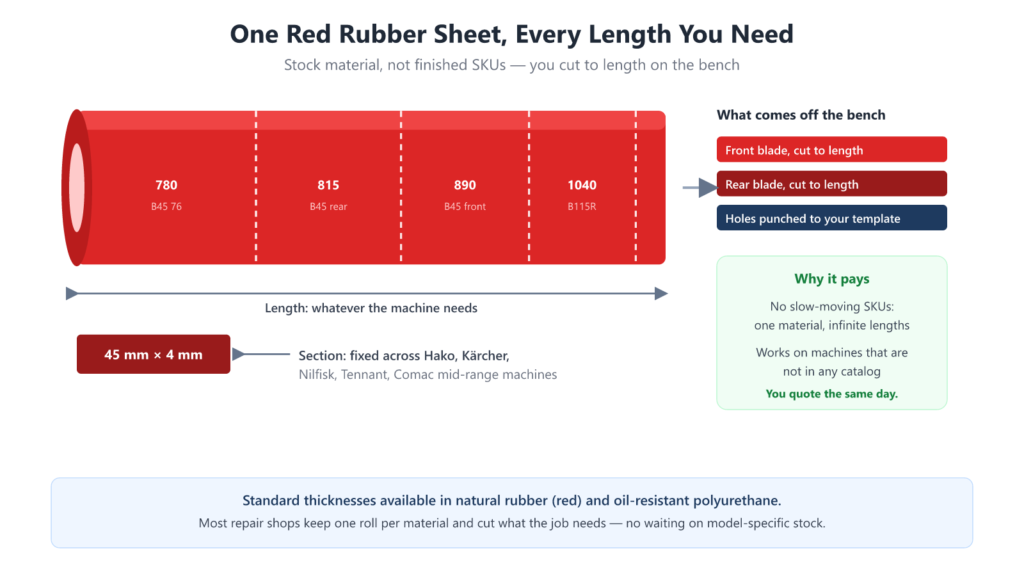
From the previous article on Hako B45 and B115R blades: five different blade lengths across two machine families — 780, 815, 890, 1,040 and 1,230 mm.
And the cross-section on every single one: 45 mm wide, 4 mm thick.
That pattern is not a Hako quirk. Across mid-range walk-behind and ride-on machines from Hako, Kärcher, Nilfisk, Tennant and Comac, blade sections repeat constantly while lengths vary by model. Length is the variable. Section is the constant.
Stock the constant. Cut the variable.
The inventory math
Consider the two models side by side.
Finished blades by model. Every new machine you take on is a new SKU. Each SKU needs its own bin, its own reorder point, and its own minimum order. Sell two blades a year from a bin of twenty and the other eighteen sit there, ageing, absorbing your working capital.
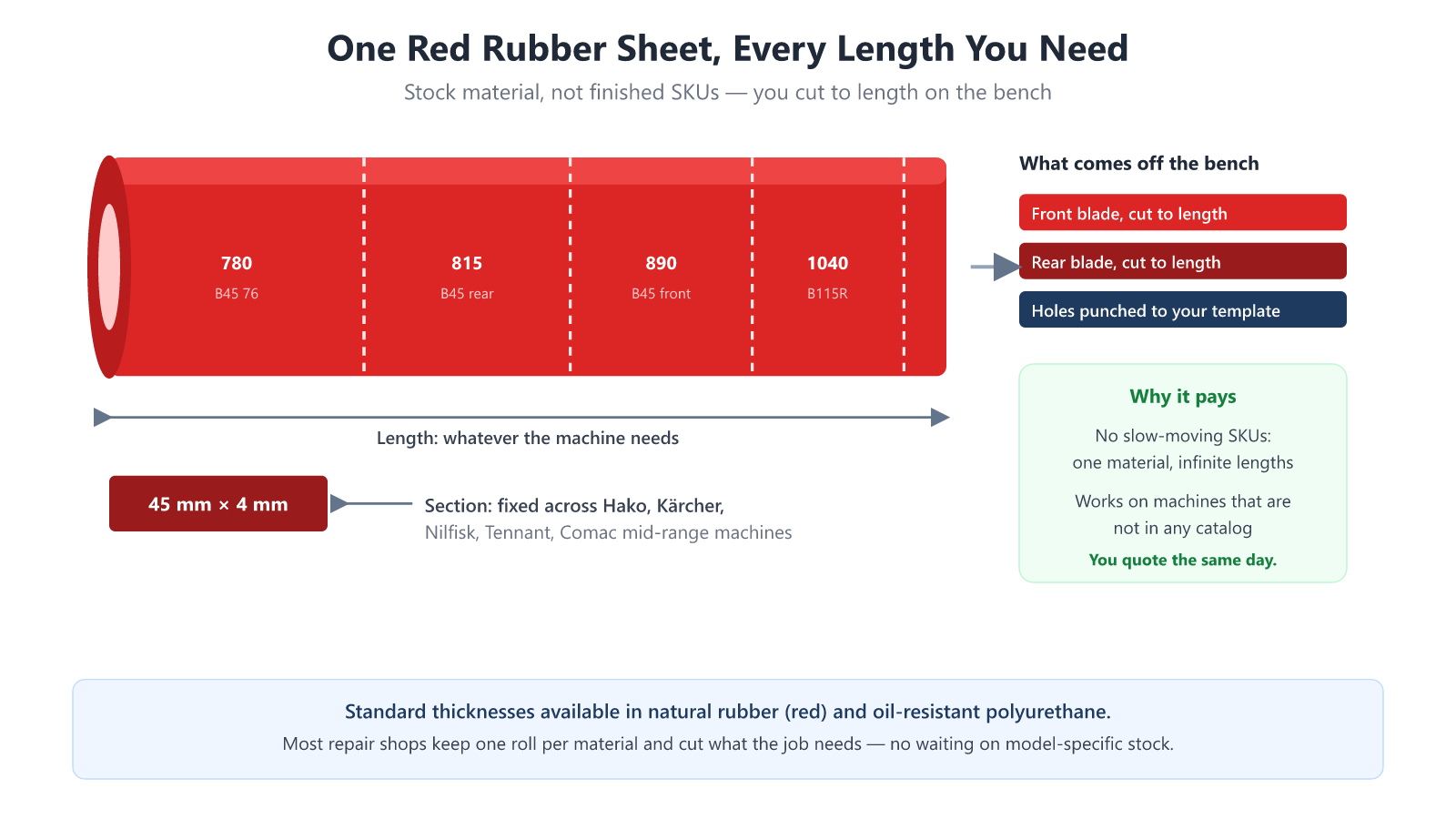
Sheet material by section. One roll of 45 × 4 mm red rubber covers every length those machines will ever need. The stock that services a B45 also services a B115R, and anything else you meet with the same section. Nothing expires. Nothing becomes obsolete when a model is discontinued — because you were never stocking the model. You were stocking the material.
The economics come down to one line: finished SKUs age; raw material doesn’t.
What you can do at the bench
With a sheet and basic tools, a workshop can do things no catalog can:
- Cut any length the job needs — including the oddball machines nobody publishes parts for any more
- Replace front and rear from the same sheet, so one bin covers both
- Quote same-day, because the part is already on the shelf
- Serve legacy and grey-import machines where part numbers simply don’t exist
Material choice matters too. Red natural rubber is the workshop standard: good resilience, excellent floor contact, friendly price. On oily or chemical-loaded floors it swells and fails early — that’s a polyurethane job, and the same cutting logic applies to a PU sheet. We explain the full trade-offs in our blade material comparison.
The honest limitation: mounting holes
A cut strip is not yet a blade. It needs mounting holes or slots to fit the squeegee frame, and this is where the sheet approach earns or loses its keep.
Three ways shops handle it:
- Punch on site. If you have a punch or press, transfer the hole pattern from the old blade and drill or punch to match.
- Keep a hole template per machine family. One aluminium template per platform pays for itself quickly.
- Order pre-punched from us. Send the hole pattern once — a drawing, a photo with measurements, or a sample blade — and we supply the sheet pre-punched to your pattern in production quantity. From then on, cutting to length is the only work left.
Option 3 is how most of our repair-company customers actually run it: we punch, they cut, nobody stocks finished SKUs.
Sourcing the sheet
Minimum orders for sheet material are far friendlier than for finished blades, because there is no die, no cutting jig and no model-specific work in a sheet. Tell us the section you need — 45 × 4 mm covers the Hako families discussed here — the material (natural rubber or PU), and the length you want on the roll.
For a full comparison of sheet versus finished blades versus OEM parts, see the sourcing framework.
Request a sheet specification
Tell us your most common machine families and we’ll recommend the section, material and roll length that covers them — including pre-punched patterns if you want the bench work reduced to a single cut.