Aftermarket replacement parts — not genuine OEM parts. The squeegee blades and rubber parts on this page are aftermarket replacements made to fit the machines named here (Nilfisk and Tennant). They are not genuine parts from those manufacturers, we are not affiliated with or endorsed by them, and brand names, model names and part numbers are used for fitment reference only. Confirm dimensions against your own sample or drawing before ordering.
Importing floor scrubber rubber strips is a straightforward way for distributors, service companies and OEM buyers to cut unit cost on a part that reorders all year. The savings are real. So is the failure mode: an incompatible or under-specified strip reduces water recovery, raises complaint volume, and gets replaced more often than the one it replaced — which is how a cheap part becomes an expensive part.
Selection comes down to four questions. Answer them in order.
1. Which strip type does your machine actually use?
A squeegee assembly is not one blade, it is a system. The front blade dams and slows the water, the vacuum slot behind it extracts, and the rear blade makes the final wipe. Front and rear are different profiles and are replaced together as one set — so “1 set = front + rear blade”, and a 20-set order is 40 pieces. Some platforms (Tennant T7, T12, T16, T20; Nilfisk BR855) add side blades, sold separately.
Before you choose a material, confirm the assembly. Our cross-reference guide lists 75 models across 17 brands, and if yours is not there we build to a sample or drawing.
2. What floor and what soil?
This decides the compound, and it is the decision buyers most often skip.
| Grade | Hardness | Use on | Do not use on |
|---|---|---|---|
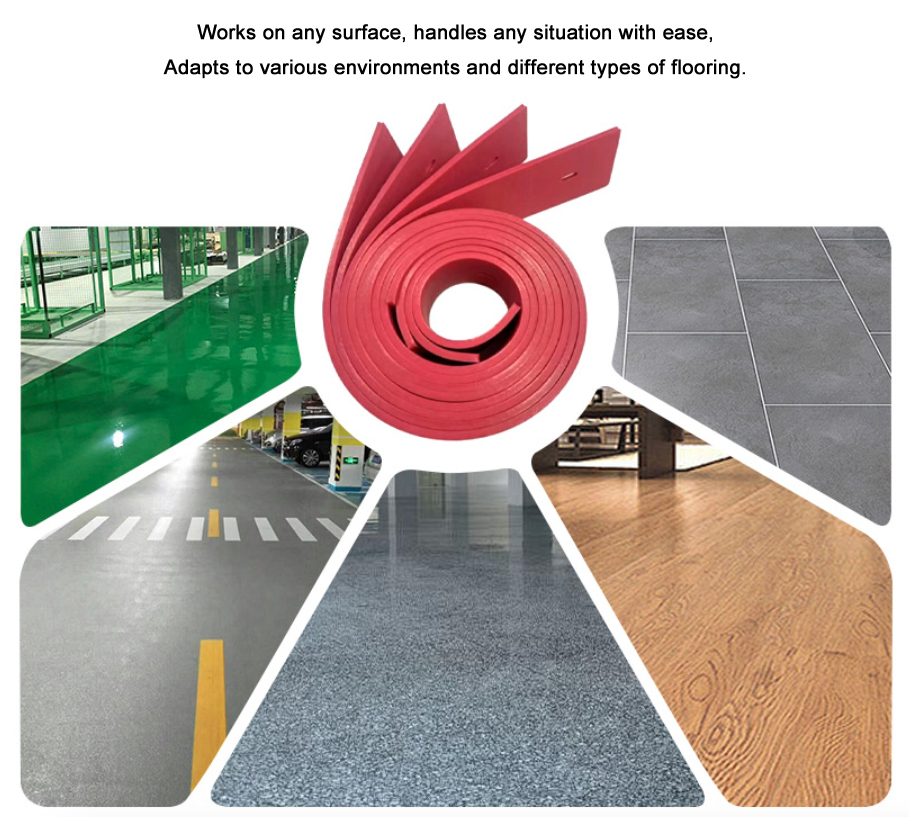
| NR-65 red natural rubber | 65 ± 5 Shore A | Tile, PVC, epoxy; standard commercial scrubbing | Oily or greasy floors |
| PU-85 cast polyurethane | 85 ± 5 Shore A | Rough concrete, grease, oil, aggressive detergents | Polished smooth tile where a stiff edge skips |
| GR-45 gum rubber | 45 ± 5 Shore A | Smooth tile, light duty, price-driven tenders | Abrasive or oily floors |
The costly error is natural rubber in an oily environment. It absorbs oil, loses structural integrity, goes wavy and stops sealing — sometimes within weeks — and the symptom looks like a machine fault rather than a specification fault.
3. What are the operating conditions?
Three variables move service life more than material choice does:
- Frequency — hours per shift and shifts per day
- Floor condition — smooth, cracked, expansion joints, rough concrete
- Chemistry and temperature — detergent pH, degreasers, hot water
Polyurethane handles oil and aggressive chemistry far better than natural rubber, but it is more sensitive to these variables than natural rubber. So a PU blade in a hot, chemically aggressive process is not automatically the upgrade it looks like on paper. Say what the machine actually runs through before the grade is fixed.
On hardness: treat it as a fitment setting. 50–75 Shore A for smooth floors, 85–95 Shore A for rough or oily floors. Too soft and vacuum pressure folds the edge under the frame; too hard and it rides over floor texture instead of sealing into it.
4. Can the supplier hold the specification?
Ask for three numbers per batch — DIN abrasion loss, tensile strength and rebound — and ask whether they are measured on production batches or quoted from a generic datasheet. Then ask for the tolerances actually held: ours are length ±1.0 mm, thickness ±0.2 mm, hole pitch ±0.5 mm. A strip that is out on hole pitch will not seat; out on thickness, it will not clamp. Neither shows up in a product photo.
One more question worth asking, because it is a reliable tell: is red rubber the same as Linatex? No. Red is pigment. Performance comes from the compound. A supplier who sells the colour instead of measured figures is selling the colour. Our material comparison sets out what to ask for instead.
Getting to the right order
| Decision | Guideline |
|---|---|
| Model already tooled | MOQ 20 sets per style, no tooling |
| New profile or hole pattern | USD 60–120 tooling, waived at 500 sets (about USD 0.12–0.24 per set) |
| Covering several models | Mixed order allowed, USD 3,000 minimum order value |
| Verifying before committing | Charged sample, 7–15 days |
| Branding | Private label and custom cartons available |
The 20-set entry point exists so you can validate a model with real customers before warehousing it. Use the first order for breadth across the models your fleet actually runs, then concentrate volume on what reorders.
What to check when the cartons land
- Dry-fit one strip onto a scrap frame before releasing the batch
- Check length, thickness and hole pitch against the tolerances above
- Inspect the wiping edge for nicks, flash or waviness
- Spot-check durometer with a handheld gauge
If something is wrong, the policy is: raise it within 7 days of receipt; manufacturing defects are covered — damaged edges, flash, wrong dimensions, hardness outside the agreed range; only the defective pieces are replaced; freight is on the buyer, which in practice means replacements travel with your next order; and we ask for an unboxing video so the claim is factual.
How long should it last?
In normal commercial use, roughly two to three months per blade — a typical industry figure, not a guarantee. Where the profile allows, rotating the blade to use both edges is free additional life. If you want to turn replacement intervals into a predictable reorder calendar, see our blade replacement cycle guide.
Frequently Asked Questions
Can I mix grades in one order?
Yes, subject to the USD 3,000 minimum order value.
What if I do not know my model number?
Send the machine plate, or a sample of the worn blade with overall length and hole spacing noted.
Do you sell sheet stock as well as finished strips?
Yes. Repair shops that cut their own blades usually buy sheet — see red rubber sheet for squeegee blades.
Is there a warranty?
No warranty language. A specific replacement policy instead, on the terms above.
Confirm your specification
Send the machine model, floor type and cleaning chemistry, and we will recommend a grade, confirm the dimensions we hold, and quote within one business day.