Aftermarket replacement parts — not genuine OEM parts. The squeegee blades and rubber parts on this page are aftermarket replacements made to fit the machines named here (Nilfisk and Tennant). They are not genuine parts from those manufacturers, we are not affiliated with or endorsed by them, and brand names, model names and part numbers are used for fitment reference only. Confirm dimensions against your own sample or drawing before ordering.
A squeegee blade set is a consumable, which means you will buy it again and again — and every repeat purchase either compounds a good decision or compounds a bad one. The ten checks below are the ones that actually separate a blade that seals from one that streaks. They take about fifteen minutes to work through once, and then they are reusable for every machine in your fleet.
1. Establish what “a set” contains
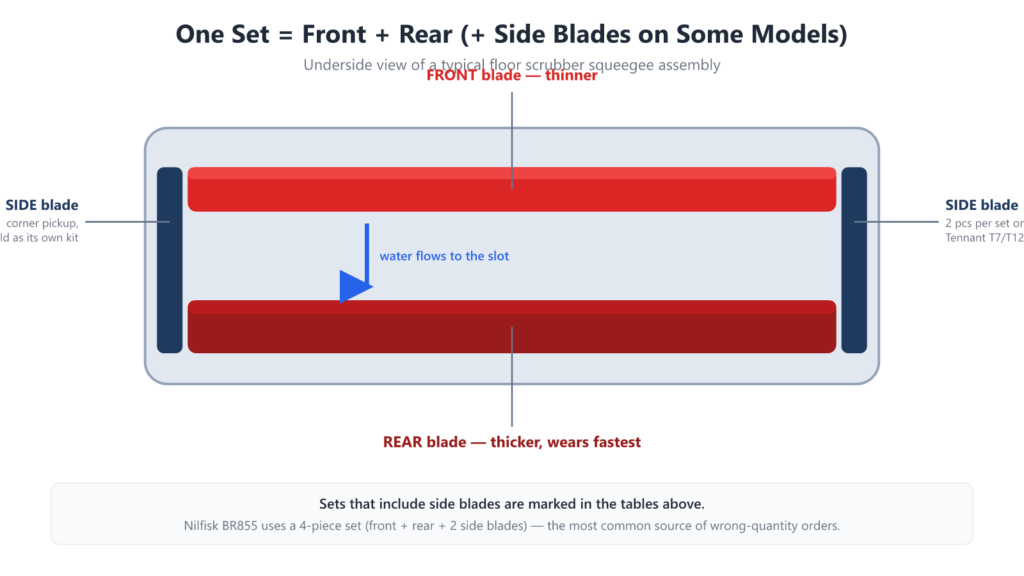
Buying by the piece is how fleets end up with 40 rear blades and no fronts. Standard practice is 1 set = one front blade + one rear blade, replaced together. The front blade dams the water, the vacuum slot extracts it, the rear blade does the final wipe — they wear at different rates but the assembly only performs as a pair. Side blades, where fitted (Tennant T7/T12/T16/T20, Nilfisk BR855), are a separate line item.
2. Identify the machine, not the part number you were given last time
Model and year matter more than a catalogue code, because OEMs revise squeegee frames. If you know the model, our cross-reference guide covers 75 models across 17 brands and will tell you what fits. If the machine is not listed, a sample or a drawing is enough for us to build to.
3. Match the material to the floor and the soil
| Grade | Hardness | Good on | Bad on |
|---|---|---|---|
| NR-65 red natural rubber | 65 ± 5 Shore A | Tile, PVC, epoxy — general commercial | Oil and grease |
| PU-85 cast polyurethane | 85 ± 5 Shore A | Rough concrete, oily floors, strong detergents | Polished tile where a stiff edge skips |
| GR-45 gum rubber | 45 ± 5 Shore A | Smooth tile, light duty | Abrasive or oily floors |
This is the single highest-leverage decision in the whole purchase. A natural rubber blade in a food plant absorbs oil, goes wavy and stops sealing — and the buyer usually blames the machine. The full argument is in our material comparison.
4. Check hardness against floor texture
Hardness is a fitment setting, not a quality ranking. Roughly: 50–75 Shore A for smooth flooring, 85–95 Shore A for rough or oily flooring. Too soft and vacuum pressure folds the edge under the frame; too hard and the edge rides over the texture instead of sealing into it. Both look like “the blade is worn” from the operator’s seat.
5. Verify the dimensions before you verify the price
Ask for length, thickness, slot type and hole pitch in writing, and check them against the tolerances the supplier actually holds. Ours are length ±1.0 mm, thickness ±0.2 mm, hole pitch ±0.5 mm. A blade that is out on hole pitch will not seat, and a blade that is out on thickness will not clamp — neither problem is visible in a product photo.
6. Ask what the supplier measures, per batch
DIN abrasion loss, tensile strength and rebound are the three numbers that predict service life. Ask whether they are measured on your batch or quoted from a generic datasheet. Also worth asking directly: is red rubber the same as Linatex? No — red is pigment. Performance comes from the compound. Anyone selling you a colour instead of a measured abrasion figure is selling you a colour.
7. Buy a grade that fits the chemicals you use
Detergent pH, degreasers and temperature all attack rubber compounds differently. Polyurethane handles oil and aggressive chemistry far better than natural rubber, but it is also more sensitive to temperature and operating conditions than natural rubber — so if your process involves hot water or aggressive degreasers, say so before the grade is chosen, not after.
8. Read the replacement terms, not the warranty language
What you want is a specific, executable policy. Ours: claims raised within 7 days of receipt; manufacturing defects covered — damaged edges, flash, wrong dimensions, hardness outside the agreed range; only the defective pieces replaced, not the whole batch; freight on the buyer, usually handled by shipping replacements with your next order; and an unboxing video as proof. Anything vaguer than this is unusable the day you need it.
9. Calculate cost per month, not cost per blade
A cheap blade that lasts five weeks is more expensive than a better one that lasts twelve. In normal commercial use a blade runs roughly two to three months — a typical industry figure, not a guarantee — and cleaning frequency, floor condition, temperature and chemicals all move that number. Where a blade can be rotated to use both edges, do it; it is free life. Our replacement cycle guide turns this into a reorder calendar.
10. Decide where you are buying from, and why
OEM, or aftermarket? For a wear part with guaranteed fitment, aftermarket usually wins on margin and lead time; the reasoning and the arithmetic are laid out in OEM vs aftermarket squeegee blades. If you are buying to resell, ask about private label — it is available, and it is the difference between moving boxes and building a brand.
Frequently Asked Questions
How often should I replace the set?
Roughly every two to three months in normal use. Treat it as an industry figure, not a promise.
Can I mix materials in one order?
Yes. Mixed orders are allowed with a USD 3,000 minimum order value.
What is the minimum quantity?
20 sets per style for models already tooled. New profiles carry a USD 60–120 mould charge, waived at 500 sets.
Do you supply repair shops as well as distributors?
Yes — repair shops and service companies are a core customer. If you cut blades from stock rather than buying finished kits, see red rubber sheet for squeegee blades.
Get a fitment confirmation
Send the machine model — or a sample and a drawing — and we will confirm what fits, recommend a grade for your floor, and quote within one business day.