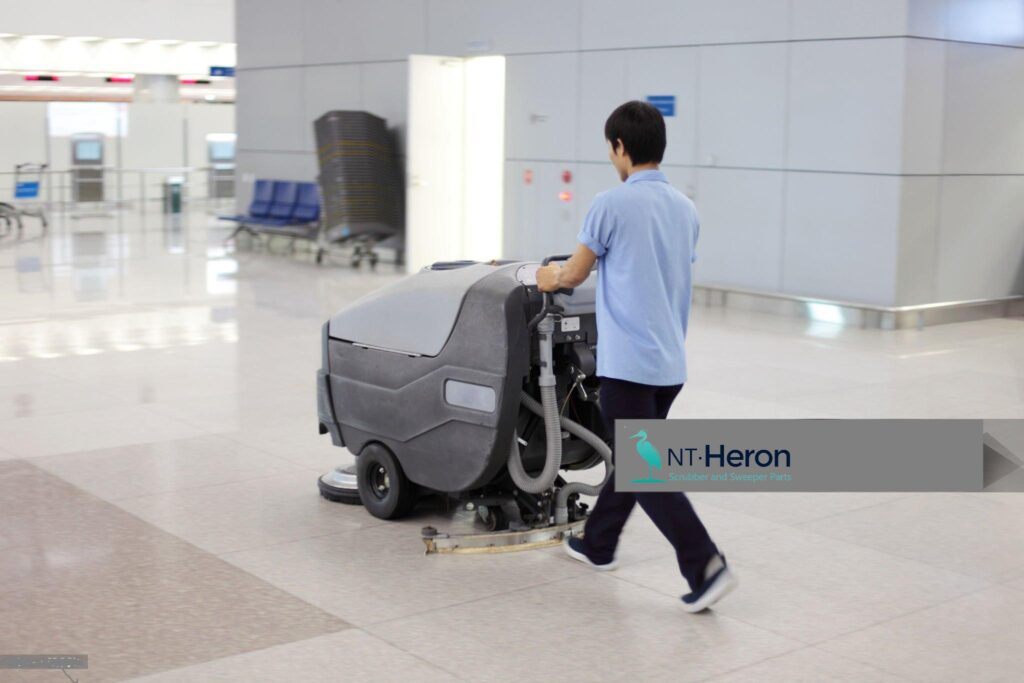
Aftermarket replacement parts — not genuine OEM parts. The squeegee blades and rubber parts on this page are aftermarket replacements made to fit the machines named here (Nilfisk and Tennant). They are not genuine parts from those manufacturers, we are not affiliated with or endorsed by them, and brand names, model names and part numbers are used for fitment reference only. Confirm dimensions against your own sample or drawing before ordering.
A distributor’s catalogue is a bet on which parts customers will need again. Structural components — motors, batteries, tanks — are replacement business you hope never happens, and when it does, the customer usually goes back to the OEM. Wear parts are the opposite: they fail on a predictable cycle, the customer needs them immediately, and the buying decision is made on availability and fitment rather than brand loyalty.
That is where the repeat revenue is. Here is how to build the wear-parts side of a floor scrubber business properly.
Separate the catalogue into three behaviours
| Part | Failure pattern | Your strategy |
|---|---|---|
| Squeegee blades and rubber strips | Predictable, every 2–3 months | Stock deep, private label, highest margin |
| Vacuum and drain hoses | Irregular, damage-driven | Stock common diameters, cut-to-length |
| Brushes, pads, filters | Scheduled, tied to service intervals | Bundle with blade orders |
| Motors, batteries, tanks | Rare, capital-grade | Quote on request, do not stock |
The mistake distributors make is treating all four rows the same and ending up with capital in batteries and nothing on the shelf for the part that reorders twelve times a year.
Squeegee blades: the anchor line
A squeegee assembly uses a front blade to dam the water and a rear blade to make the final wipe, with the vacuum slot extracting between them. They wear at different rates but are replaced together, which is why the trade unit is 1 set = front + rear blade. Some platforms — Tennant T7, T12, T16, T20 and Nilfisk BR855 among them — add side blades as a separate set of two.
Three things decide whether this line makes money for you:
Fitment coverage. Your customers run mixed fleets. Covering 75 models across 17 brands is the difference between quoting every enquiry and quoting one in five — see the cross-reference guide for the full list.
Grade by floor, not by price. Stock natural rubber (NR-65) for tile, PVC and epoxy, and cast polyurethane (PU-85) for rough concrete and oily floors. A distributor who sends natural rubber into a food plant gets the blade back, and then loses the account. The full trade-off is in our material comparison.
Entry quantity. At 20 sets per style for models already tooled — or a USD 3,000 mixed order spanning several models — you can open a new brand line without warehousing a container. New profiles carry USD 60–120 in tooling, waived at 500 sets. That is roughly USD 0.12–0.24 per set at the waiver point, which is why own-brand blades are now viable for mid-size distributors and not just importers.
Hoses: the second line worth carrying
Vacuum and drain hoses fail from damage and chemical attack rather than on a schedule, so the pattern is irregular but the urgency is high — a machine with a split hose is down today. Stock the common diameters in bulk length and cut to order. Custom lengths are worth offering; they convert a “we will get back to you” into a same-day answer.
Bundling: turn a part into a service habit
Blades and brushes are both scheduled. If you know a customer’s fleet and their cleaning frequency, you can quote a quarterly kit — blades, pads, filters — and take the whole reorder off their plate. This is the single most effective thing a distributor can do to make the account sticky, and it works because the alternative for the customer is remembering to order. Our blade replacement cycle guide shows the interval arithmetic.
What to demand from your supplier
- Batch-measured specifications — DIN abrasion loss, tensile strength and rebound measured per batch, not quoted from a datasheet
- Stated tolerances — we hold length ±1.0 mm, thickness ±0.2 mm, hole pitch ±0.5 mm
- Written replacement terms — claims within 7 days of receipt, manufacturing defects covered, only the defective pieces replaced, buyer covers freight (usually consolidated into the next order), unboxing video as proof
- Honest answers on materials — red rubber is not automatically Linatex. Red is pigment. Ask for measured figures.
- Private label and custom cartons — if you cannot put your name on the box, you are building someone else’s brand
Where aftermarket fits
Customers accept aftermarket on wear parts once fitment is guaranteed, and they resist it on structural parts. That asymmetry is the whole commercial case, and the margin arithmetic is set out in OEM vs aftermarket squeegee blades. If you are also serving repair shops that cut their own blades from stock, the red rubber sheet line is the one to carry alongside finished kits.
Frequently Asked Questions
What margin should I expect on blades?
It depends on your market, but the reason distributors lead with blades is that the reorder cycle is two to three months rather than two to three years.
What is the minimum to open a line?
20 sets per style for tooled models, or a USD 3,000 mixed order.
Can I carry my own brand?
Yes — private label and custom printed cartons are available.
Do you support repair shops as well?
Yes. Both finished kits and sheet stock, depending on whether the shop cuts its own.
Build the wear-parts side first
Send us the machine models your customers run and we will tell you which ones we already tool, recommend grades by floor type, and quote a starter mix within one business day.