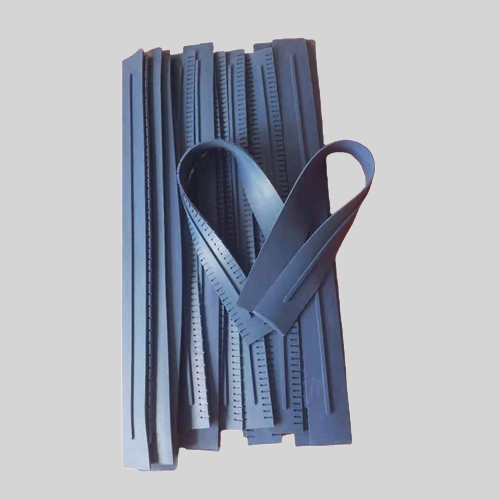
Aftermarket replacement part — not a genuine OEM part. The squeegee blades and rubber parts on this page are aftermarket replacements made to fit Karcher machines. They are not genuine Karcher parts, we are not affiliated with or endorsed by Karcher, and brand names, model names and part numbers are used for fitment reference only. Confirm dimensions against your own sample or drawing before ordering.
Two Karcher BD 530 scrubbers can sit in the same bay, carry the same badge, and still need different squeegee blades. The difference is rarely made at the factory — it is made later, by a frame swapped in service, a strip trimmed to length, or a technician drilling one more hole. “What actually fits” is therefore a question about the machine in front of you, not a catalogue. Below: a fitment record per assembly, the three near-miss failures, and the terms that let one shipment cover several assembly states.
The nameplate is the least reliable part of the machine
A model name identifies a machine family, not the squeegee assembly bolted to it today. That assembly is a replaceable sub-assembly: it wears, it bends, it gets swapped between units, and it is often one of several options across a production run. Slot width, lip geometry, thickness, hole pitch, length and how a strip is clamped all live in the assembly, not the badge.
The Karcher official site confirms the family and which configurations were offered — identification, not a parts list. It will not say whether your frame was revised in production, taken from a donor machine, or re-drilled on site. We do not publish dimensions, OEM part numbers or DIN abrasion values we cannot confirm, or fill a gap with a number that merely looks close. Where a figure is missing, confirm it against your own sample or drawing and check with us before ordering.
Three things make one BD 530 diverge from another. Different builds: a family can ship with more than one squeegee width, and with straight or curved assemblies. An assembly replaced in service: a frame from a donor unit or a revised spare changes the profile while the nameplate stays the same. Field modification: trimming a strip, punching an extra hole, or shimming a clamp creates a new profile, usually undocumented. A flat strip forced into a curved channel lifts at both ends and leaves two wet trails blamed on the vacuum motor — geometry, not rubber.
Our cross-reference guide lists the profiles we already tool: a starting list to confirm against the worn blade, not a promise that a badge maps to one profile. A swapped frame counts as a new profile with its own reference.
Build a fitment record per assembly
If one badge covers several assemblies, keep a short record against each. It takes minutes while the machine still runs and removes nearly all ambiguity from a replacement enquiry.
Keep the worn set. Retain the worn front blade and the worn rear blade tagged with your own sample ID. Photos help; a retained set is what a dimension is checked against. Lay delivered pieces against it — profile, length, cut and hole positions — before fitting.
Record the assembly. Note whether the frame is straight or curved and photograph it from above with the blade in place. That view settles a question no compound can fix.
Record the context. Floor type, detergent and wash-water temperature, how oily or gritty the surface is, shift length and fleet size. That decides the compound, not the badge; we use it to recommend a grade, never to invent a dimension.
One distinction belongs at the top of every enquiry: one set is one front blade plus one rear blade. The rear holds the vacuum seal; the front takes the debris and most of the abrasion. An enquiry saying only “BD 530 blades” is often priced as single strips, so state the split before anyone quotes and ask for carton labelling by style and by half of the set. Keep sample IDs per assembly, because the assembly is what the blade must fit.
Why “almost fits” is the expensive outcome
A blade that will not bolt on is cheap: the error is found at the fitting bench. The expensive failures pass that first check. Three near-misses have different causes and fixes.
A blade that mounts but lifts at one or both ends is geometry — wrong curvature, length or lip angle; no rubber change seats it. One that mounts and seals but chatters on polished tile is a compound problem: a hard lip skips on smooth floors, and extra down-pressure makes it worse. One that swells, goes tacky or hardens and cracks is chemistry or temperature; changing the grade without changing the detergent or wash-water temperature buys the same failure again.
All three tend to be reported as a bad batch of rubber. A retained worn set shows whether the old blade wore evenly, lost its edge in one place, or deformed — enough to point at geometry, compound or chemistry before ordering. Our material comparison sets out the trade-off, the replacement cycle guide turns the interval into a reorder point, and the red rubber sheet guide explains why colour is pigment, not performance.
Choosing a compound for the BD 530
Specify hardness as a range with a tolerance and a named test method, not a single number. Durometer is measured by ASTM D2240, and classification and batch-to-batch consistency are framed by ASTM D2000. Ask for readings off production pieces rather than a compounder’s coupon: the coupon proves the mixer, the production piece proves the tool. All three grades carry a ±5 Shore A tolerance:
- Natural rubber, 65 ± 5 Shore A — smooth tile, PVC and sealed epoxy; conforms well to flat floors, the default for most indoor commercial work.
- Cast polyurethane, 85 ± 5 Shore A — rough or damaged concrete, expansion joints, oily surfaces and long abrasive shifts; generally lasts longest there.
- Economy gum rubber, 45 ± 5 Shore A — light duty on smooth floors where price leads and the area is small.
Polyurethane is more sensitive to temperature and operating conditions than natural rubber. It suits named rough or oily accounts, not every site: a cold, unheated bay or a hot wash can take the edge off its advantage. Service life in normal commercial duty is typically two to three months, an industry figure rather than a guarantee; it moves with cleaning frequency, chemicals, temperature and floor condition. A grade right six months ago can be wrong now if the floor, detergent or wash-water temperature changed.
Terms that make several assembly states affordable
- MOQ 20 sets per style on a profile we already tool.
- USD 60–120 tooling for a new style, waived once cumulative volume reaches 500 sets.
- Mixed orders allowed, with a USD 3,000 minimum order value, so one shipment tests several profiles or grades.
That third line makes a fleet with two or three BD 530 assembly states cheap to cover: a mixed shipment carries a 20-set trial of each profile alongside grades you already sell. Consolidating styles into fewer, larger orders is standard in the cleaning channel, and ISSA material helps make that case internally. The margin sits in the gap against a captive OEM parts channel, an argument developed in OEM vs aftermarket squeegee blades. Cumulative volume counts across reorders, so a stable profile moves toward the tooling threshold. Samples are chargeable, not free, and take 7–15 days to prepare and ship; a profile we do not already tool adds a cutting step. Budget that window before the current set is due.
What the seven-day window requires
Claims are agreed on the order, not after it. The window is 7 days from receipt, counted from the delivery date rather than dispatch; only the defective pieces are replaced, not the whole batch; an unboxing video filmed from before the carton opens is required; and freight on replacement pieces falls to the buyer, usually absorbed into the next shipment. Coverage is for manufacturing defects — damaged edges, wrong dimensions, hardness outside the agreed range — not ordinary wear, fitting damage or a compound wrong for the floor.
The deciding evidence is created in the first minutes at the goods-in door: photograph the unopened carton, label and first layer of blades, and count front and rear pieces separately against the purchase order. A fitment record per assembly means comparing against a retained set from that machine, not a generic expectation. A wet floor is a facilities issue too — OSHA 1910.22 is the US reference for keeping walking surfaces safe.
Get a quote or a sample set
Send a worn front and rear blade or clear photos, a view showing whether the assembly is straight or curved, the floor and chemical context, wash-water temperature, fleet size, and your sample ID for each assembly. We will confirm the profile against your sample or drawing, say whether we hold tooling, recommend a grade and quote a 20-set trial. Request pricing or a sample set and we will come back with lead time and freight options.
The badge tells you which family you bought. The assembly tells you what actually fits.