In commercial cleaning, floor scrubber downtime is expensive. Stop streaking machines immediately to prevent slips and floor damage. In 90% of cases, a worn, damaged, or poorly adjusted squeegee blade causes poor water recovery.
And for facility managers and maintenance supervisors, knowing when to change squeegee blades—and how to maximize their lifespan—is essential for controlling operational budgets. For B2B parts distributors, educating your clients on these maintenance protocols builds trust for your replacement parts inventory.
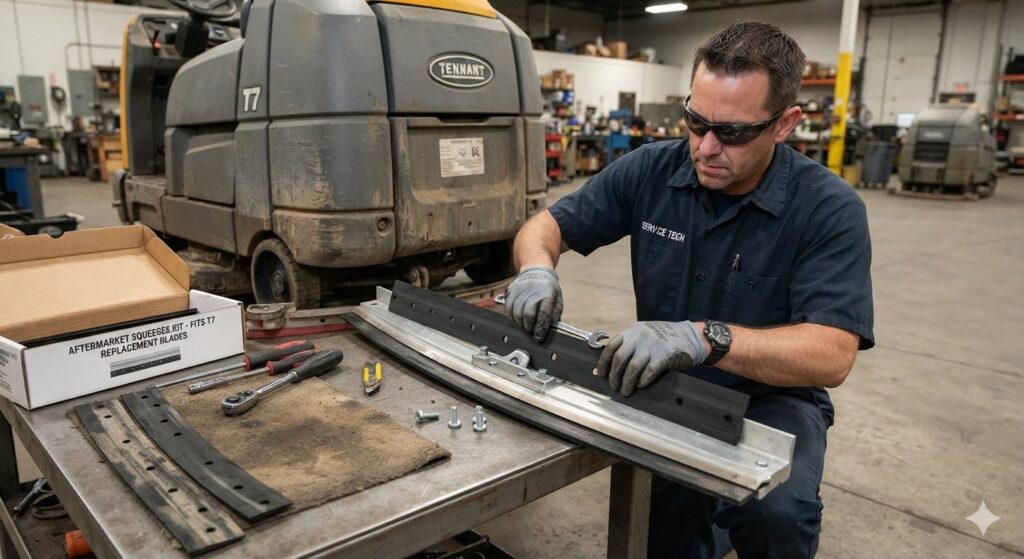
Top Signs Your Floor Scrubber Squeegee Blade Needs Attention
Inspect rubber blades daily before operation. Look for these mechanical and structural warning signs:
Visible Water Streaking
First, The most obvious sign of failure is a trail of water lines left behind the machine. If a floor scrubber requires to dry a flat surface, the squeegee edge has lost its crisp, square profile. As the leading edge rounds off due to friction, it begins to hydroplane over the water rather than scraping it into the vacuum hoses. It has slip-and-fall hazards if there some water on the floor.
Tearing, Gouging, or Pitting
Second, commercial floors are often litter with sharp debris, such as staples, wood splinters, screws, or coarse grit. When a machine runs over these items under heavy down-pressure, they can cut or gouge the squeegee blade. A single microscopic tear creates an immediate air leak, dropping the local vacuum pressure to zero and leaving an un-cleared patch of water.
Warping and Wavy Edges
Finaly, Blades warp due to incompatible chemicals or incorrect storage. Parking a ride-on scrubber overnight with the squeegee down permanently deforms the rubber, creating a wavy edge that prevents a proper floor seal.
The 4-Edge Benefit: How to Rotate and Flip Blades to Save Costs
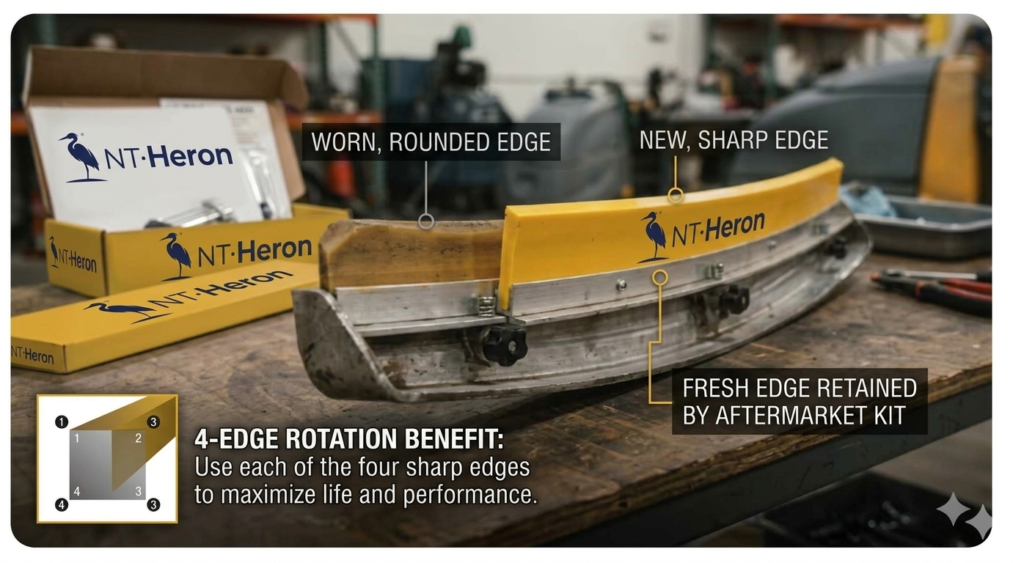
One of the greatest design features of modern commercial squeegee blades is their symmetrical geometry. Manufacturers engineer most premium blades to be reversible, featuring four distinct working edges. This means facility managers can achieve up to four times the operational life out of a single blade before buying a replacement, provided they follow proper rotation schedules.
Step-by-Step Blade Rotation Protocol:
- Remove the Assembly: Loosen the thumb screws or quick-release clamps on the squeegee tool frame and remove the entire assembly from the machine.
- Inspect the Active Edge: Identify which of the four edges is currently facing down and toward the front of the machine.
- Flip Vertically: If the bottom-front edge is rounded, unclamp the blade, flip it upside down, and re-secure it. You are now using the top-front edge.
- Flip Horizontally: Once you exhaust both edges on the front face, flip the blade front-to-back. This brings the two completely fresh edges from the back face into the active, forward-facing position.
Transitioning to High-Quality Wholesale Replacements
Once a blade’s four edges degrade, operators cannot rotate it. Running exhausted blades overworks the vacuum motor, causing premature failure and high repair costs.
Exhausted Squeegee Blades —> Weak Air Seal —> Suction Motor Overworks —> Motor Burnout (Expensive Repair)
However, to prevent these cascading maintenance failures, facility managers should maintain a steady on-site stock of high-quality aftermarket wholesale blades. Sourcing direct from a verified manufacturer ensures an immediate, precision-molded replacement when a blade wears out, minimizing machine downtime. Furthermore, checking related high-wear components like the squeegee tool assembly housing and the flexible wastewater extraction hoses during every blade change ensures the entire recovery system operates at peak efficiency.