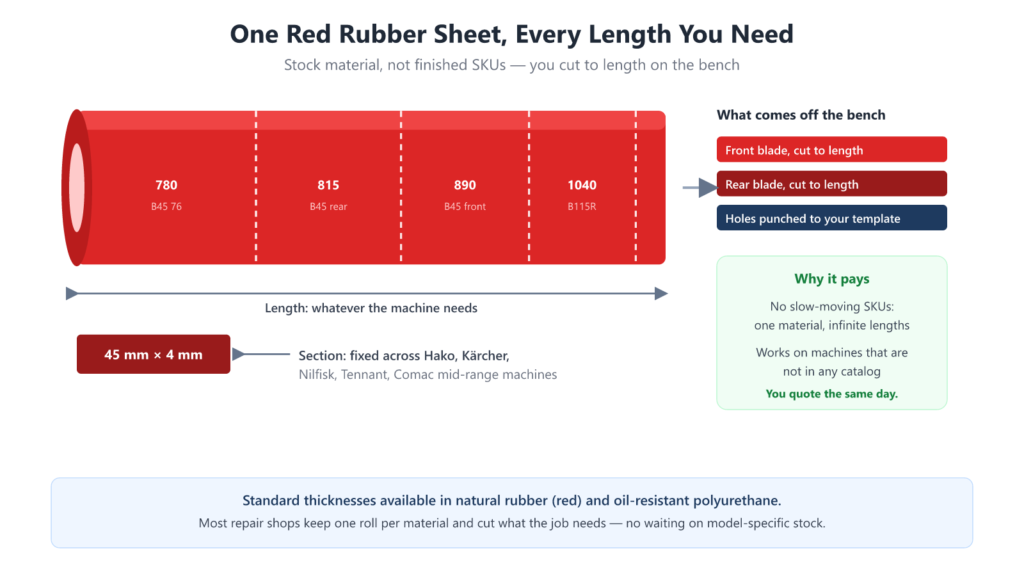
Buying rubber sheet looks like the simplest purchase in the catalogue: a material, a thickness, a roll length. It is also one of the easiest to get quietly wrong, because the properties that decide whether the sheet works are not the ones printed largest on the quotation.
If you are buying sheet to cut squeegee blades — the most common reason repair companies and service departments buy it — there are six parameters that matter and two commercial traps worth knowing about.
The six parameters
1. Compound, chosen by what it will meet
The compound decides chemical behaviour, and this is the parameter that cannot be corrected later.
| Compound | Resists | Fails against | Use where |
|---|---|---|---|
| Natural rubber (NR) | Abrasion, tearing, general wear | Oil, grease, many solvents | Tile, PVC, epoxy; general commercial floors |
| Polyurethane (PU) | Abrasion, oil, grease, aggressive detergents | High temperature, sustained cold | Rough concrete, oily floors, food plants |
| Gum rubber | Nothing in particular — it is soft and cheap | Abrasion, oil, heat | Smooth floors, light duty, price-led work |
Red rubber is not automatically Linatex. Red is pigment. The honest claim is measured abrasion loss, and a supplier who sells you “Linatex” on the basis of colour is selling pigment. The full comparison is in our material comparison.
2. Hardness, matched to the floor
Hardness is not a quality grade — it is a fitment decision:
- 50–75 Shore A — smooth floors. Softer compounds conform and hold vacuum.
- 85–95 Shore A — rough, oily or abrasive floors. Harder compounds resist wear.
Too soft folds under vacuum; too hard skips over texture and leaves water behind. Harder is not better, it is different.
3. Thickness and its tolerance
Thickness determines how the strip seats in the blade channel and how it flexes. What matters as much as the nominal figure is the tolerance held across the sheet — a sheet that varies by 0.5 mm edge to edge produces blades that fit inconsistently, and the variation only shows up at the machine.
Specify thickness ±0.2 mm and ask whether that is measured or assumed.
4. Tensile and tear strength
Abrasion resistance gets the marketing attention; tear strength decides whether the blade survives a chipped concrete floor or a bolt hole that concentrates stress. Ask for both:
- Tensile strength — resistance to pulling apart
- Tear strength — resistance to a cut or nick propagating
- DIN abrasion loss — the number behind “wear resistant”
A supplier quoting only one of the three is quoting the one that looks best.
5. Roll dimensions and yield
For cutting blades, roll size is a yield question. A wider roll means fewer offcuts for a given blade length, and the offcut rate is real money over a year. Ask:
- Available widths, and which width minimises waste for your blade lengths
- Whether length is sold by weight or by metre — by weight means thickness variation changes what you receive
- Minimum order per width
6. Batch consistency
This is the parameter that separates a supplier from a source. Consistent sheet means every blade cut this quarter behaves like the one cut last quarter. Ask for batch hardness and density records; a supplier who measures per batch can show you the record, and one who cannot will send a generic datasheet.
The two commercial traps
Trap one: price quoted without specification
Sheet is often quoted as “natural rubber sheet, 3 mm” with no hardness, no tolerance and no abrasion figure. That quote cannot be compared to anything, because it does not describe a material — it describes a shape.
Two quotes that look 20% apart are frequently 100% apart once hardness and tolerance are specified, and the cheaper one is usually the one that varies.
Trap two: minimum order quoted in weight
When sheet is sold by weight, thickness tolerance works against you — thicker sheet means fewer metres per kilogram, and you pay for material you did not want. For blade cutting, buy by dimension.
What this means for cutting your own blades
If you are buying sheet to cut blades rather than buying finished sets, the economics turn on three things:
Yield per roll. Every offcut is waste. Choose widths against your most common blade lengths. Our red rubber sheet guide sets out how repair shops size this.
Consistency of cut. A sheet with stable thickness and hardness cuts predictably and fits predictably. Variation here costs technician time, which is the expensive part.
When to stop cutting and buy tooled blades. Cutting makes sense for unusual lengths, urgent one-offs and low-volume models. Once a model reorders regularly, a tooled blade is cheaper and fits better — tooling runs USD 60–120 per style, waived at 500 sets cumulative, with MOQ 20 sets per style thereafter.
Mixed supply. Buying sheet for the odd sizes and tooled sets for the volume models is the normal pattern. Mixed orders at USD 3,000 minimum value let one shipment cover both. The 75 models already tool across 17 brands are listed in the cross-reference guide.
Quality checks on arrival
Do these before the sheet goes into stock:
- Measure thickness at five points across the sheet, including both edges.
- Check hardness with a durometer against the specified value — tolerance ±5 Shore A.
- Inspect the surface for pitting, inclusions and visible layering.
- Cut one blade and dry-fit it onto a scrap frame before releasing the roll to the workshop.
- Keep the batch reference so a later problem can be traced to a specific delivery.
Agree the replacement terms before paying: claims within 7 days of receipt, manufacturing defects covered, defective material replaced rather than the whole shipment, freight on the buyer, and an unboxing video so a claim raised later is still factual.
Frequently Asked Questions
Is red rubber the same as Linatex?
No. Red is pigment. Linatex-class performance is a measured abrasion figure, and it should be quoted as one.
What hardness should I buy?
50–75 Shore A for smooth floors, 85–95 Shore A for rough or oily ones. Match the floor, not the price.
Should I buy by weight or by dimension?
By dimension for blade cutting. Buying by weight means thickness variation changes what you receive.
Do you supply samples?
Yes, charged, 7–15 days. They are made to order rather than pulled from stock.
What is the minimum order?
For sheet, per width as quoted. For tooled blade sets, 20 sets per style, or a mixed order at USD 3,000 minimum value.
Get the specification matched
Tell us the blade lengths you cut, the floors they run on, and the sheet widths you use, and we will recommend a compound and hardness, and quote sheet plus tooled sets in one shipment.