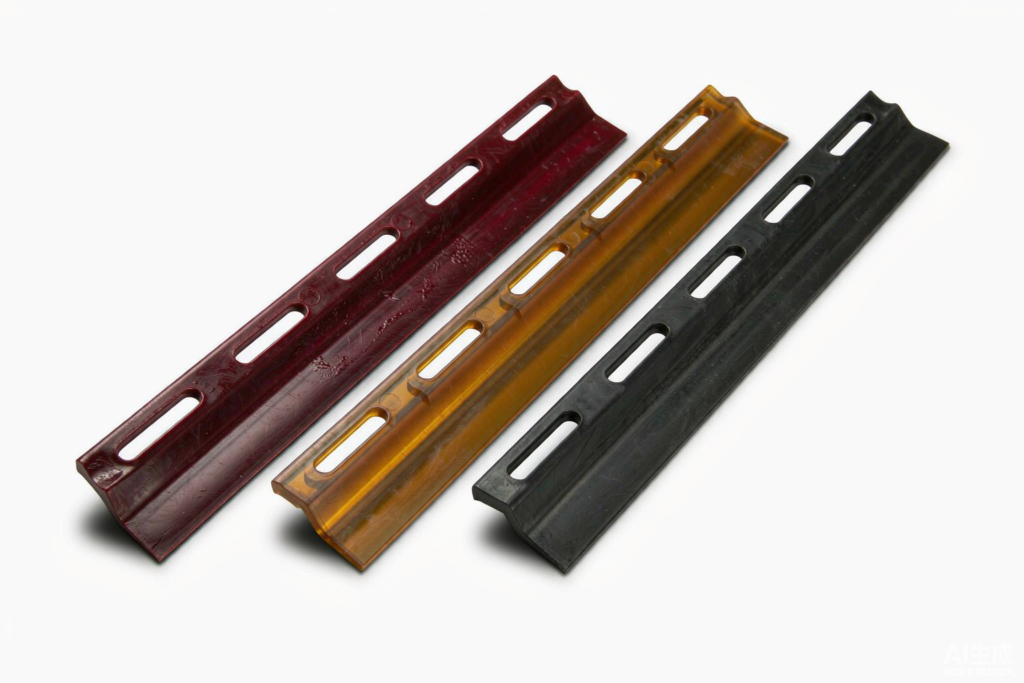
A squeegee blade is usually described by what it is: a strip of rubber or polyurethane bolted to the recovery tool of a floor scrubber. It is more useful to describe it by what it has to survive, because the specification that works in a warehouse will fail in a food plant, and the one that works in a food plant is over-specified for a retail floor.
Below are the industrial applications where blade choice actually changes the outcome, and what to specify in each.
First, what the blade is doing
The blade is not wiping the floor. It is holding a seal against the floor while vacuum pulls the dirty water behind it. When it works, the floor is left dry. When it fails, water is left behind — and the failure is almost always one of three things:
| Failure | Visible symptom | Root cause |
|---|---|---|
| Water left behind | Streaks, puddles, dry-looking patches that are still wet | Blade too hard for the surface, or worn edge |
| Blade folds or chatters | Juddering, uneven edges, noise | Blade too soft for the surface, or vacuum too high |
| Edge deforms or swells | Wavy edge, rapid softening | Chemical attack — wrong compound for the residue |
Those three account for nearly every blade complaint, and each has a different fix. Full diagnostic logic is in our material comparison.
1. Warehouses and distribution centres
The duty: large areas, polished or sealed concrete, forklift traffic, occasional oil and tyre marks.
Specify: polyurethane, 85 ± 5 Shore A. Concrete is abrasive and the surface is rarely as smooth as it looks; a harder compound resists the abrasion and survives the grit that forklifts track in. Where oil is present at all, natural rubber is the wrong choice — it swells and softens.
Watch for: assuming the floor is smooth because it looks smooth. Sealed concrete is hard on blades.
2. Food and beverage processing
The duty: frequent washdown, fats and oils, hot water, aggressive degreasers, strict slip-resistance requirements.
Specify: polyurethane for oil and chemical resistance, and change on a calendar rather than on appearance. In this environment a blade that still looks serviceable may already have lost its seal.
Watch for: the compliance dimension. A wet floor in a food plant is not a cleaning complaint, it is an incident. The cost of one slip dwarfs the cost of every blade on the machine, which is why calendar-based replacement is standard here. Our replacement cycle guide covers how to set that interval.
3. Cold storage and freezers
The duty: low temperature, condensation, smooth floors, short working windows.
Specify: a compound that stays flexible at temperature. This is the one application where the general rule “polyurethane lasts longer” needs qualifying — polyurethane is more sensitive to temperature and operating conditions than natural rubber, and in sustained cold that matters more than abrasion resistance.
Watch for: blades that are fine at ambient and stiff inside the freezer. Test in the cold, not at the door.
4. Manufacturing and engineering plants
The duty: cutting fluids, metal swarf, rough or damaged concrete, heavy traffic.
Specify: the hardest compound that still seals — typically 85–95 Shore A polyurethane. Swarf and chipped concrete tear soft compounds.
Watch for: over-hardening. A blade that skips over a rough floor leaves water behind, and on a floor with metal debris that is a safety issue. If streaking appears after hardening, the floor needs a softer compound or the surface needs repair.
5. Car parks and loading bays
The duty: very rough surfaces, de-icing salt, grit, hydrocarbons, often cleaned by larger ride-on machines.
Specify: maximum abrasion and chemical resistance. This is the shortest-life application and the one where blade cost per month, not per blade, is the only sensible comparison.
Watch for: expecting warehouse life. Blades do not last here, and no compound changes that — plan the reorder accordingly.
6. Retail, healthcare and education
The duty: smooth surfaces, public foot traffic, appearance-led.
Specify: softer compounds — 50–75 Shore A — because the priority is conformance and a dry, streak-free finish rather than maximum abrasion life.
Watch for: fitting a hard industrial blade because it “lasts longer”. On polished tile it will chatter and streak, and in a public area the streaks are what people notice.
The specification table
| Application | Surface | Compound | Hardness |
|---|---|---|---|
| Warehouse | Sealed concrete | Polyurethane | 85 ± 5 Shore A |
| Food processing | Tiled, epoxy, wet | Polyurethane, calendar-replaced | 80–90 Shore A |
| Cold storage | Smooth, cold | Temperature-tolerant compound | Test in situ |
| Manufacturing | Rough, swarf, oils | Polyurethane | 85–95 Shore A |
| Car parks | Very rough, salt, fuel | Polyurethane, max abrasion | 90–95 Shore A |
| Retail / healthcare | Smooth tile, PVC | Natural or gum rubber | 50–75 Shore A |
Fitting, tolerance and reordering
Across every application, three things hold:
Tolerance decides whether it fits. Length ±1.0 mm, thickness ±0.2 mm, hole pitch ±0.5 mm, hardness ±5 Shore A. Hole pitch is the most common cause of a blade that looks correct and will not mount square.
Replace front and rear together. One set is one front blade plus one rear blade. Replacing only the visibly worn one puts the machine back on the floor within weeks.
Order by the fleet, not by the machine. Mixed orders at USD 3,000 minimum value, with 20 sets per style on tooled models, let one shipment cover a mixed fleet. Where a profile does not exist, tooling is USD 60–120 per style, waived at 500 sets cumulative. The 75 models already tool across 17 brands are in the cross-reference guide.
Frequently Asked Questions
Which lasts longest, rubber or polyurethane?
Polyurethane typically lasts roughly three to five times standard rubber in abrasive duty — an industry benchmark, not a guarantee. It is not the right answer on smooth floors, where softer compounds seal better.
How often should industrial blades be changed?
In normal commercial service roughly two to three months; shorter in rough or chemically aggressive duty. Measure one cycle and set the calendar from your own result.
Can one blade type cover all our sites?
Rarely. Mixed estates need two or three compounds. Standardise per route or per site type.
What if the blade does not fit?
Claims within 7 days of receipt on manufacturing defects, defective pieces replaced, freight on the buyer, unboxing video required. Agree it before payment.
Specify by application
Tell us the sites, the floor type in each, and what gets tracked in. We will recommend a compound per application and quote a 20-set trial across the fleet.