Rubber sheet is one of the least glamorous materials on a mine site and one of the most consequential. It lines chutes, seals skirt boards, protects structural steel and absorbs impact at every transfer point. When it is specified correctly nobody notices it; when it is specified wrongly it fails in weeks and takes conveyor availability with it.
This guide is written for buyers who source sheet rather than moulded linings — distributors, maintenance suppliers and plant engineers who cut and fit on site.
Decide the failure mode before choosing a grade
The most common specification error is ordering “wear-resistant rubber sheet” without naming what actually destroys it. The four mechanisms behave differently and they pull the compound in opposite directions:
- Impact — large lumps hitting a surface. Energy has to be absorbed, so you want a soft, resilient compound with enough thickness to deform.
- Sliding abrasion — fine material travelling across a surface. You want a harder compound that resists being ground away.
- Cutting and gouging — sharp, angular material carried under pressure. This is where tear strength matters more than hardness.
- Chemical, oil and heat — process chemicals, diesel contamination or elevated temperature attack the polymer itself, regardless of how hard it is.
Impact wants soft. Sliding abrasion wants hard. Because both happen at most transfer points, the answer is usually a compromise chosen by whichever mechanism dominates — and that judgement is what separates a six-month liner from a six-week one.
Where the sheet goes
| Application | Dominant mechanism | Practical starting point |
|---|---|---|
| Chute and hopper liners | Impact, then sliding | Soft-to-medium NR, thicker section at the impact zone |
| Skirt board sealing | Sliding abrasion | Medium NR strip, replaceable, set with a small gap |
| Transfer point impact beds | Heavy impact | Soft NR pad over steel support structure |
| Screen decks and screen mats | Wet sliding abrasion | Medium-to-hard compound; many sites prefer cast polyurethane here |
| Bin and truck body liners | Impact plus sliding | Medium NR, thick enough not to deform through to the steel |
| Pump and cyclone interiors | Fine wet abrasion | Usually moulded rather than sheet; confirm before specifying sheet |
| Pulley lagging | Belt slip wear | Medium-hard NR, bonded and grooved |
| Dust curtains and seals | Flexing, low wear | Soft NR or SBR, thin gauge |
| Wear pads and buffers | Impact | Soft NR, low durometer, high rebound |
| Walkway and stair anti-slip | Foot traffic | Weather-resistant compound with a moulded pattern |
The single most useful reference in that table is the skirt board line: conveyor sealing failures are a well-documented source of spillage, dust and housekeeping cost, and the Conveyor Equipment Manufacturers Association publishes practical guidance on skirt and sealing practice. If you are buying sheet for belt lines specifically, their material is worth reading before you write a specification.
Durometer: put numbers on it, then verify them
Hardness is quoted on the Shore A scale and tested by the ASTM D2240 durometer method. Two practical notes:
First, tolerance. A realistic production tolerance is ±5 Shore A. A supplier quoting ±1 either does not understand their own process or is quoting something they will not hold across batches. Second, always state the test method in the enquiry. “60 durometer” without ASTM D2240 is not a specification you can reject against.
Our own sheet programme runs three families, graded the way we grade squeegee stock:
- Natural rubber, 65 ± 5 Shore A — the general-purpose mining sheet. High resilience, good cut and tear resistance, the right default for most impact and slurry duty.
- Cast polyurethane, 85 ± 5 Shore A — for severe sliding abrasion and where oil or hydrocarbons are present. It outlasts rubber substantially in the right duty, and it is correspondingly more sensitive to temperature and operating conditions, so it needs a conversation rather than a substitution.
- Economy compound, 45 ± 5 Shore A — for sealing, curtains and low-wear protection where price decides.
The comparison logic is set out in more detail in our material comparison — the same analysis applies whether the rubber ends up on a scrubber or in a chute.
The four test figures worth asking for
Hardness alone tells you almost nothing about wear life. When you compare quotes, ask for these and check which method each was tested to:
- Abrasion loss — the closest proxy for service life in sliding duty. Lower is better. Insist on the stated test method and compare like with like.
- Tensile strength, normally tested to ASTM D412. It is a basic quality screen; a compound that cannot hold tensile is usually under-cured or heavily extended.
- Tear strength — this is number one for cut-and-gouge duty, ahead of hardness.
- Specific gravity — genuinely useful and rarely requested. It is the quickest way to detect a heavily filled compound: cheap calcium carbonate adds weight without adding wear life, and a sheet that feels heavy for its size is a warning sign rather than a reassurance.
The same applies to colour. It proves nothing — red means pigment was added, not that any particular compound was used.
Thickness: buy against downtime, not against price
The instinct is to specify thin sheet because it is cheaper per square metre. The better question is what a liner change costs you in lost production, labour and disposal.
- Under 6 mm — sealing, dust curtains, light protection. Easy to cut and form by hand.
- 6–12 mm — general chute and hopper lining, skirt sealing. The common working range.
- Above 12 mm — impact zones and anything taking large lump. Heavier to handle, needs mechanical fixing or bonding, and usually worth the extra cost per m² because it is replaced less often.
Our sheet range runs 3 mm to 20 mm. Anything requiring a section beyond that is normally handled as a moulded or fabricated part rather than sheet, and it is worth asking early rather than discovering it at the enquiry stage.
Installation determines whether specification survives contact
A correctly specified liner can still fail in weeks if it is fitted badly:
- Substrate preparation is not optional. Steel must be clean, dry and profiled. Adhesive onto scale, rust or moisture is calendar-managed failure.
- Bonding needs primer plus a two-coat adhesive system, applied at the spread rate the adhesive manufacturer specifies, with the correct open time before mating.
- Mechanical fixings carry load where it matters. Clamp bars or countersunk bolts at edges and in high-impact zones; do not ask adhesive alone to hold a liner against falling rock.
- Cure time is real. Do not put the plant back into service early to save an hour.
Any work in or around operating plant falls under the mine’s safety regime — in the US, MSHA requirements, which are published by the Mine Safety and Health Administration. Isolation, lock-out and confined-space procedures belong in the job plan before the sheet arrives, not after.
Sourcing from China: where the risk actually is
For most overseas buyers the price advantage is real and the risks cluster in three places rather than being spread evenly.
Batch consistency, not first-sample quality. Any competent factory can make one good sheet. Ask how hardness and thickness are sampled across a production run, and what happens when a batch falls outside tolerance. Request the inspection record for the actual batch shipped, not a generic certificate.
Specification drift. A quote answered against “black rubber sheet 60 Shore A” will be made to whatever compound was cheapest that week. Write the full specification: mechanism, durometer with method, thickness with tolerance, key test figures, roll dimensions.
Hidden freight cost. Sheet is heavy and bulky; freight can move the landed cost more than a small unit price difference. Compare delivered cost, and check how the supplier packs it — sheet creased or pressed flat in transit arrives distorted.
Two habits help. Trial a roll in one location before a full change-out, keeping a sample of what you approved. And agree replacement terms before paying: claims within 7 days of receipt, manufacturing defects covered, only defective pieces replaced, freight on the buyer, documented on arrival.
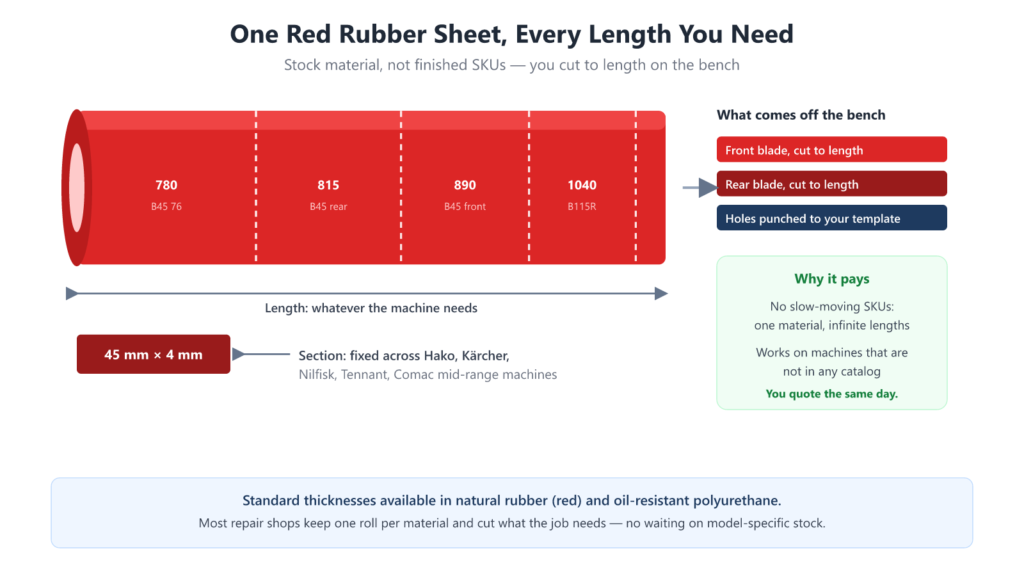
Our own sheet programme operates on the same terms we publish for squeegee stock: samples are charged rather than free, typically 7–15 days to prepare because they are made to your specification rather than pulled off a shelf, and tooling is USD 60–120 per profile, waived at 500 sets. Sheets cut to size, custom gauges and private-label packing are all available — see the note on ordering red rubber sheet for further guidance at /red-rubber-sheet-for-squeegee-blades/.
Frequently Asked Questions
Is thicker always better?
No. In sliding-abrasion duty a thin, harder sheet often outlasts a thick, soft one. Thickness belongs where there is impact energy to absorb.
Can I use one grade everywhere on site?
You can, and many sites do. You will pay for it either in shortened life at impact zones or in overspending on areas that never need premium compound. At minimum, split into impact and sliding groups.
What is the realistic tolerance on hardness?
±5 Shore A. Treat tighter claims with scepticism and always name ASTM D2240 in the enquiry.
Does colour indicate quality?
No. Colour is pigment. Compare measured abrasion loss, tensile and tear figures instead.
How do I start if I am replacing an unknown sheet?
Send a sample. Measuring the properties of what already works is more reliable than guessing from a catalogue.
Tell us the application, the dominant wear mechanism and your thickness requirement, and we will recommend a grade, quote the sheet against a written specification, and send a sample piece you can put into service before you commit.