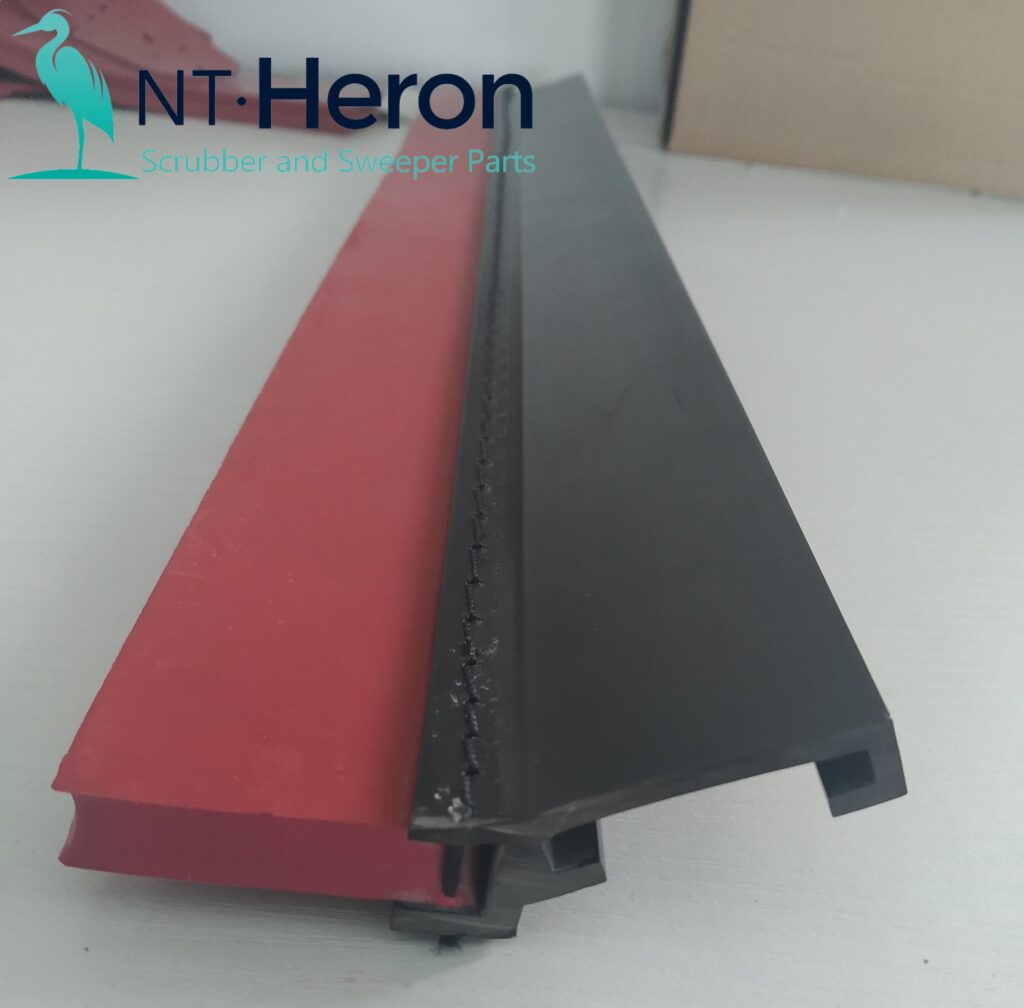
Streaks after scrubbing are the most common complaint in floor care, and the most misdiagnosed one. The instinct is to replace the blade, and about half the time that is wrong — because streaking is a symptom with at least six causes, and only some of them live in the rubber.
This guide works through them in the order a technician should actually check them, cheapest first. It applies to a standard 24-inch squeegee assembly as much as to any other width: the width changes the parts you buy, not the logic.
What a streak actually is
A streak is a thin film of dirty water the squeegee failed to recover. That is all. So the question is never “is the blade bad” — it is “why did water get past the seal”. Which gives you six places to look.
1. Check the vacuum path before the blade
Two minutes, no parts:
- Recovery tank full, or float switch stuck
- Vacuum hose split, blocked, or off its port
- Drain hose leaking water back onto the floor
- Tank lid gasket not sealing
- Debris screen or filter clogged
If suction at the squeegee mouth is weak, no blade will fix it. Streaking with weak suction is a vacuum problem wearing a blade costume.
2. Inspect the wiping edge
Turn the assembly over and run a finger along the edge (carefully). You are looking for:
- Rounding — the edge has worn from a crisp square into a curve
- Nicks and tears — usually from debris or sharp aggregate
- Waviness — a blade that has taken a permanent set and will not sit flat
- Swelling or softening — the classic sign of natural rubber exposed to oil
A worn edge is the most common genuine cause, and on most assemblies the rear blade goes first, because it makes the final wipe. Front and rear are replaced together as one set — 1 set = front blade + rear blade — since the assembly only performs as a pair.
3. Clean the blade and the frame
Grit, string, label residue and dried detergent sit on the edge and hold it a millimetre off the floor. One millimetre is a streak. Wipe the blades at the start and end of every shift and flush the assembly — this is free and it is the fix most often skipped.
4. Check fitment, not just wear
Streaking on a brand-new blade usually means the wrong part. Fitment is dimensional: length, thickness, slot pattern and hole pitch. A blade from a visually similar machine will often mount and still leak. Ours are held to length ±1.0 mm, thickness ±0.2 mm, hole pitch ±0.5 mm, and we dry-fit the first article before a batch goes out.
For a 24-inch assembly, confirm the actual blade length and the hole pitch rather than the nominal machine width — nominal widths round, and rounded numbers leak.
5. Check the material against the floor
This is the mis-specification that gets reported as a quality problem.
| Floor and soil | Grade | Hardness |
|---|---|---|
| Smooth tile, PVC, epoxy | Natural rubber NR-65 | 65 ± 5 Shore A |
| Rough concrete, oil, grease, aggressive detergents | Cast polyurethane PU-85 | 85 ± 5 Shore A |
| Smooth tile, light duty | Gum rubber GR-45 | 45 ± 5 Shore A |
A natural rubber blade on oily concrete absorbs oil, goes wavy and stops sealing — sometimes inside a month. And harder is not automatically better: too hard and the edge skips over texture instead of sealing into it. Roughly, 50–75 Shore A for smooth floors, 85–95 Shore A for rough or oily ones. One more correction: red rubber is not automatically Linatex. Red is pigment; ask for measured abrasion, tensile and rebound. The full selection logic is in our material comparison.
6. Check the geometry
Even a perfect blade streaks if the assembly is out of attitude:
- Level across the width — one end riding high leaks at that end. Level the assembly, not the blade.
- Tilt — too little and it skips; too much and it folds under and squeals.
- Worn squeegee casters or wheels — they quietly change the geometry.
- Down-pressure — more pressure is not the fix for a leak. It accelerates wear and usually makes streaking worse.
7. Check the technique and the chemistry
- Speed — too fast and the vacuum cannot keep up; the fix is a slower pass, not a new part
- Detergent dose — excess foams, foam kills water recovery, and it leaves film that reads as streaking
- Water temperature — hot solution and aggressive degreasers attack compounds differently; polyurethane is more sensitive to these variables than natural rubber
The dual-blade advantage
If your assembly uses a front and rear blade, you already have the best anti-streak design there is: the front dams and slows the water, the vacuum slot extracts, and the rear makes the final wipe. It only works if both edges are sound and the slot between them is clean. Cleaning that slot is a five-second job that prevents a lot of call-outs.
Storage and handling
Spare blades last longer in the box than on the machine, but only if stored flat, cool, out of sunlight and away from solvents. Do not hang them by a hole, and do not stack heavy items on the wiping edge — a blade stored bent will be fitted bent.
How long should a blade go before this starts?
In normal commercial use, roughly two to three months — a typical industry figure, not a guarantee. Frequency, floor condition, temperature and chemicals all move it. If streaking starts at three weeks, you have cause 4, 5 or 6, not wear. Our replacement cycle guide shows how to turn intervals into a scheduled change rather than a complaint-driven one. And if you need to confirm the actual part for your machine, the cross-reference guide covers 75 models across 17 brands.
Frequently Asked Questions
How often should I replace squeegee blades?
Roughly every two to three months in normal commercial use, on condition rather than on a calendar.
Can I just replace the rear blade?
You can, but the front is usually close behind and the set is the trade unit. Changing both avoids a second visit.
Why does my new blade still streak?
Usually fitment, geometry, or detergent foam. Work through causes 4 to 7 in order.
What if a replacement blade is defective?
Claims within 7 days of receipt; manufacturing defects covered; only the defective pieces replaced; freight on the buyer, usually consolidated into your next order; unboxing video as proof.
Get the right blade for your floor
Tell us the machine model, the blade length and hole pitch, and the floor type — and whether there is oil or heavy detergent in the process — and we will confirm fitment, recommend a grade, and quote within one business day.