Aftermarket replacement part — not a genuine OEM part. The squeegee blades and rubber parts on this page are aftermarket replacements made to fit Tennant machines. They are not genuine Tennant parts, we are not affiliated with or endorsed by Tennant, and brand names, model names and part numbers are used for fitment reference only. Confirm dimensions against your own sample or drawing before ordering.
The Tennant T7 is one of the most widely installed mid-size ride-on scrubbers in contract cleaning, retail and warehousing. For a distributor or service company, it is also one of the most reordered squeegee blade profiles in the catalogue — which makes it the model worth getting right first.
This is what to check before you order a T7 blade set, in the order it actually matters.
Start with fitment, not material
Most blades that fail in the field do not fail because the rubber was wrong. They fail because the blade could not be mounted square, and the operator then blamed the compound.
Four numbers decide whether a T7 blade fits:
| Parameter | Tolerance to hold | What happens if it drifts |
|---|---|---|
| Length | ±1.0 mm | Too long buckles against the frame; too short leaves a dry streak at each end |
| Thickness | ±0.2 mm | Wrong thickness will not seat in the channel, or flexes instead of wiping |
| Hole pitch | ±0.5 mm | The most common reason a blade that “looks identical” will not bolt on |
| Hardness | ±5 Shore A | Too hard skips over floor texture; too soft folds under vacuum |
Hardness is measured by the ASTM D2240 durometer method, and that detail is worth knowing when you compare quotes. A supplier quoting “65 Shore A” without naming a test method, or quoting a tolerance tighter than ±5, is quoting something they will not be able to verify on a production batch. Ask for readings taken off production pieces, not off a test coupon from the compounder — the coupon proves the mixer, the production piece proves the tool.
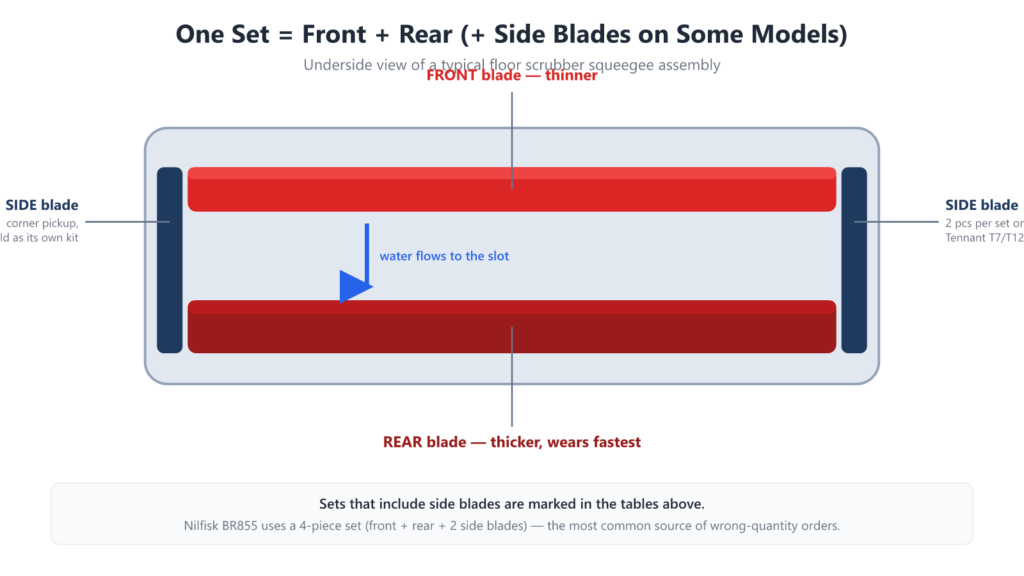
One set means one front blade plus one rear blade. That is how the part is fitted and how it should be ordered. On the T7 the rear blade does most of the water pickup and wears noticeably faster than the front, so field life is usually decided by the rear blade alone.
Pick the grade by floor, not by price
The same machine behaves completely differently on polished tile and on a sealed warehouse floor with forklift traffic. Our material comparison covers the full trade-off; the short version for the T7:
- Natural rubber, 65 ± 5 Shore A — smooth tile, PVC, epoxy. Conforms well to flat floors and gives the cleanest pickup.
- Cast polyurethane, 85 ± 5 Shore A — rough concrete, expansion joints, oily or greasy surfaces. Cut resistance is the whole point here.
- Economy gum rubber, 45 ± 5 Shore A — light duty on smooth floors where the buying decision is price-driven.
Two things buyers get wrong. The first is assuming harder is better: on polished tile a hard blade chatters and leaves streaks, and no amount of down-pressure fixes it. The second is assuming red rubber is automatically equivalent to a premium brand. Colour comes from pigment. Performance comes from formulation, and the way to compare is the abrasion loss and tensile figures, not the colour.
Service life in normal commercial duty is typically two to three months per blade — that is an industry figure rather than a guarantee, and it moves with cleaning frequency, chemicals, temperature and floor condition. Polyurethane gives the longest interval on rough or oily floors, but it is also more sensitive to temperature and operating conditions than natural rubber, so it needs to be sold with that caveat attached.
Why aftermarket economics work on this model
The commercial case for carrying an aftermarket T7 blade rather than only genuine parts comes down to reorder frequency. A machine in daily service goes through roughly four to six sets a year, which is set out in more detail in our replacement cycle analysis. Combine that with the pricing gap to a captive OEM parts channel and the arithmetic is straightforward — it is the same argument developed in OEM vs aftermarket squeegee blades.
On practical supply terms:
- MOQ 20 sets per style for profiles we already tool — 20 sets is 40 blades, which is a genuine field trial rather than a warehouse commitment
- USD 60–120 tooling for a profile we do not have, waived at 500 sets cumulative
- Mixed orders allowed at USD 3,000 minimum order value, so one first shipment can cover ten or twelve different models instead of betting on one
That combination is why own-brand blade programmes stopped being a capital decision for mid-size distributors. Compare it with the typical requirements assembled in our cross-reference guide, which maps all 75 models across 17 brands.
Put the claim terms in writing before you pay
Blade requests usually surface at goods-in, which on a long freight lane can be weeks after manufacture. Agree the process first:
- Claims within 7 days of receipt, counted from delivery, not dispatch
- Only the defective pieces are replaced, not the whole batch — if 12 of 200 are faulty, 12 are replaced
- An unboxing video is required, filmed from before the carton opens and close enough to show the defect
- Freight on replacement pieces is on the buyer; most importers absorb it by consolidating into the next shipment
Coverage is for manufacturing defects: damaged or feathered edges, wrong dimensions, defective material, hardness outside the agreed range. It does not cover ordinary wear, fitting damage, or premature wear caused by specifying the wrong compound for the floor.
Tell us the machine model and your floor type, and we will confirm the T7 profile, recommend a grade, and quote a 20-set trial you can fit before committing to volume.