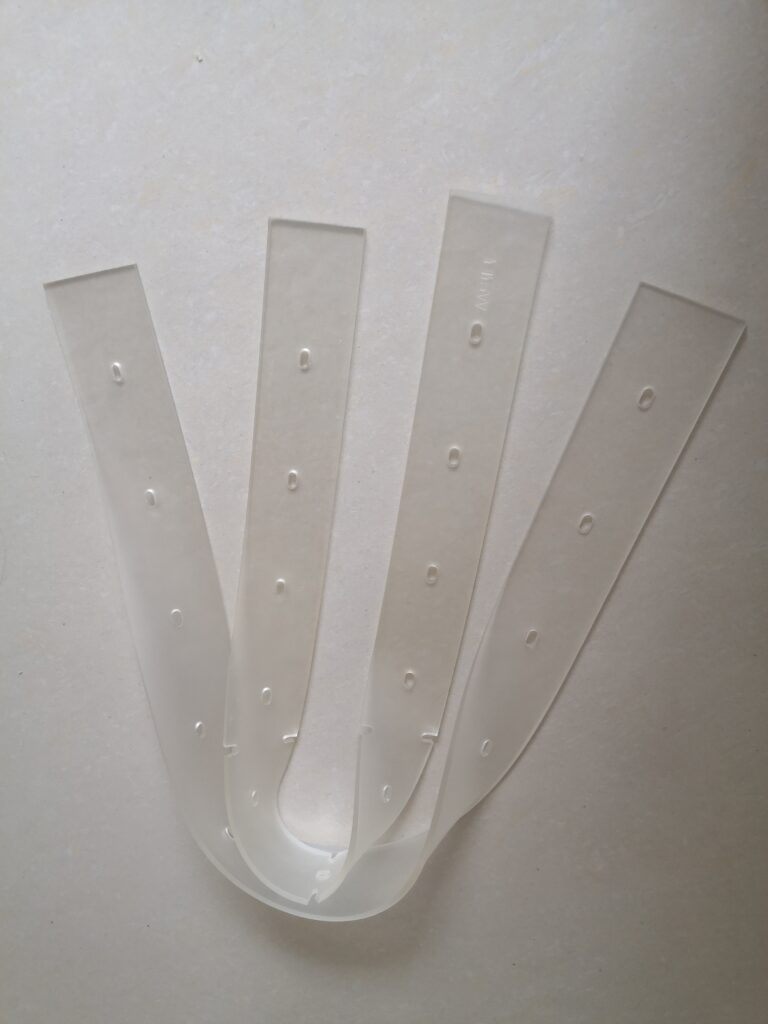
Aftermarket replacement part — not a genuine OEM part. The squeegee blades and rubber parts on this page are aftermarket replacements made to fit Tennant machines. They are not genuine Tennant parts, we are not affiliated with or endorsed by Tennant, and brand names, model names and part numbers are used for fitment reference only. Confirm dimensions against your own sample or drawing before ordering.
Tennant scrubbers are the backbone of a lot of industrial cleaning fleets, which makes Tennant squeegee kits one of the most reliably reorderable lines a distributor can carry. They are also one of the easiest lines to lose money on, because a cheap blade that fails on the first pass costs you the account, not just the part.
This is the wholesale view: what actually sits in a Tennant kit, which models matter, how to spec the material, and what the order economics look like.
Why Tennant squeegees punish generic blades
Tennant machines use a curved, parabolic squeegee assembly rather than a straight bar. The geometry is what lets the machine hold water recovery through a sharp turn instead of dumping a trail at the corner. That curve also means the blade has to flex and recover continuously along its length — a blade with inconsistent durometer or a memory-prone compound will hold shape on the straight and lift at the ends.
Two practical consequences for a buyer. First, fitment is dimensional, not visual: length, thickness, slot pattern and hole pitch all have to match, and a blade that is 1 mm proud at the ends will streak on a turn. Second, front and rear are different jobs. The front blade slows and dams the water; the vacuum slot extracts it; the rear blade makes the final wipe. When a facility reports “the machine is leaving a trail”, it is almost always the rear edge that has gone.
What “one kit” means
We sell by the set: 1 set = one front blade + one rear blade, because that is the unit the machine consumes. A 20-set order is 40 pieces. Side blades are separate on four Tennant platforms — T7, T12, T16 and T20, sold 2 pieces per set — so quote them explicitly rather than assuming they ride along.
Models we cover
| Platform | Notes |
|---|---|
| T3, T5, T7 | Compact and mid-size scrubbers, high fleet density |
| T12, T16, T20 | Mid to large riders; side blade sets available |
| T300, T500E, T600 | Walk-behind and mid-size |
| S30, M30 | Compact platforms |
| T5680, 5400 | Larger industrial units |
If your model is not on this list, send the machine plate or a sample — we build to both. Our cross-reference guide lists all 75 supported models across 17 brands.
Choosing the grade for your customers’ floors
| Grade | Hardness | Specify it when |
|---|---|---|
| NR-65 natural rubber, red | 65 ± 5 Shore A | Tile, PVC, epoxy; general commercial cleaning |
| PU-85 cast polyurethane | 85 ± 5 Shore A | Rough concrete, oil and grease, aggressive detergents |
| GR-45 gum rubber | 45 ± 5 Shore A | Smooth tile, light duty, price-led tenders |
The failure mode to avoid is natural rubber in an oily environment. It absorbs oil, loses structural integrity, goes wavy, and stops sealing — sometimes inside a month. If your customers include food processing, machine shops or automotive, lead with PU-85 and price it accordingly. Our material comparison goes through the full trade-off, including why harder is not automatically better.
What the order economics look like
Two scenarios, and the difference is tooling:
- Model already in our tool range: MOQ 20 sets per style, no mould charge.
- New profile or hole pattern: USD 60–120 mould charge per style, waived once that style reaches 500 sets.
Run that second line out and it is USD 0.12–0.24 per set at the 500-set mark — effectively free. The practical reading for a distributor is that you can develop a profile for a fleet account you have already won, without committing to a container of it. Mixed orders are allowed at a USD 3,000 minimum order value, so a first order can span the eight or ten Tennant platforms your customers actually run.
On the OEM question — whether your customers will accept an aftermarket blade at all — the margin case is set out in OEM vs aftermarket squeegee blades. Short version: buyers accept aftermarket on wear parts once fitment is guaranteed, and they do not accept it on structural parts.
Quality control and claims
Every batch is checked for hardness and thickness before despatch, and we hold our standard tolerances at length ±1.0 mm, thickness ±0.2 mm, hole pitch ±0.5 mm. If something is wrong, the policy is specific: raise it within 7 days of receipt, we cover manufacturing defects (damaged edges, flash, wrong dimensions, off-spec hardness), we replace only the defective pieces rather than the whole batch, the buyer carries freight — most customers simply take the replacements with their next order — and we ask for an unboxing video so the claim is factual rather than contested.
How often will your customers reorder?
In normal commercial use, expect roughly two to three months per blade. Treat that as a typical industry figure rather than a guarantee: cleaning frequency, floor condition, temperature and chemicals all move it, and polyurethane grades are more sensitive to those variables than natural rubber. Rotating the blade to use both edges extends the interval on some assemblies. If you want to convert that into a predictable reorder calendar for your service customers, see the blade replacement cycle guide.
Frequently Asked Questions
Do Tennant kits include side blades?
On T7, T12, T16 and T20 they are a separate set of two pieces. Everything else is front and rear only.
What is the minimum wholesale order?
20 sets per style for models we already tool, or a mixed order at USD 3,000 minimum.
Can I carry these under my own brand?
Yes — private label and custom cartons are available.
Are samples free?
No. Samples are charged and take 7–15 days, because they are made to your specification.
Get a Tennant kit quote
Send your model list — or a sample and a drawing if the machine is not listed — and we will confirm fitment, recommend a grade per floor type, and quote within one business day.