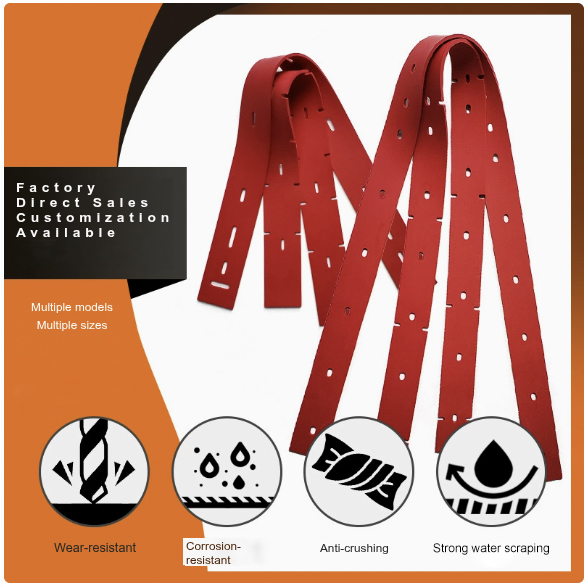
Aftermarket replacement parts — not genuine OEM parts. The squeegee blades and rubber parts on this page are aftermarket replacements made to fit the machines named here (Nilfisk and Tennant). They are not genuine parts from those manufacturers, we are not affiliated with or endorsed by them, and brand names, model names and part numbers are used for fitment reference only. Confirm dimensions against your own sample or drawing before ordering.
Importing squeegee blades in bulk is the fastest way for a distributor or a service company to cut unit cost on a wear part that customers reorder all year. It is also the fastest way to lock up cash in inventory that does not fit. The difference is almost never the price per piece — it is whether the specification was nailed down before the money moved.
Here are the ten things we walk every new wholesale buyer through before a first container. Use it as a checklist with any supplier, including us.
1. Define the unit before you discuss the price
Most disputes start here. In our catalogue 1 set = one front blade + one rear blade, because that is what a squeegee assembly actually consumes in one service. A 20-set order is therefore 40 pieces: 20 front, 20 rear.
Two consequences worth budgeting for. First, front and rear blades wear at different rates but are replaced together — the rear blade does the final wipe, so it usually goes first. Second, some machines carry side blades as a separate line item (Tennant T7, T12, T16, T20; Nilfisk BR855). Confirm whether the kit you are quoting includes them, or you will be shipping a half-fix.
2. Read MOQ and mould cost as one number, never separately
There are only two sourcing scenarios, and they behave completely differently:
| Scenario | Minimum order | Tooling |
|---|---|---|
| Model already in our tool range | 20 sets per style | No mould charge |
| New model, new profile or new hole pattern | 20 sets per style | USD 60–120 per style, waived at 500 sets |
That second row is the one buyers misread. A mould charge of USD 60–120 spread across 500 sets is USD 0.12–0.24 per set — under one percent of typical landed cost. Which means developing your own profile is not a capital project, it is a rounding error. The industry benchmark for a new profile is often USD 400–5,500 in tooling against an MOQ of 100–1,000 pieces; against that, a 20-set entry point exists so you can test a market before you warehouse it.
3. Use mixed orders to widen coverage instead of deepening one SKU
You can mix styles in a single order, subject to a minimum order value of USD 3,000. The smart use of that rule is breadth: cover eight to ten fast-moving models at 20 sets each rather than betting 500 sets on one. Your customers run mixed fleets; your first container should look like their fleet, not like your favourite SKU.
4. Specify material by floor and soil, not by unit price
| Grade | Material | Hardness | Best on | Avoid on |
|---|---|---|---|---|
| NR-65 | Natural rubber, red, Linatex-class | 65 ± 5 Shore A | Tile, PVC, epoxy — wet scrubbing | Oily or greasy floors |
| PU-85 | Cast polyurethane | 85 ± 5 Shore A | Rough concrete, oil and grease, aggressive chemicals | Very smooth tile where a hard edge skips |
| GR-45 | Economy gum rubber | 45 ± 5 Shore A | Smooth tile, light duty | Anything abrasive or oily |
The expensive mistake is not picking the cheap grade. It is putting a natural rubber blade into a food plant or a machine shop, where it absorbs oil, goes wavy, and stops sealing within weeks. For the full material argument, see our squeegee blade material comparison.
5. Treat hardness as a fitment variable, not a quality grade
Harder is not better. Too soft and the vacuum pulls the edge under the frame and it leaks. Too hard and the edge rides over floor texture instead of sealing into it. As a working rule: 50–75 Shore A for smooth floors, 85–95 Shore A for rough or oily floors. A supplier who cannot tell you which durometer suits your customers’ floors is quoting a catalogue, not solving a problem.
6. Ask for the three numbers that actually predict service life
Ask for DIN abrasion loss, tensile strength and rebound — and then ask whether each figure is measured per production batch or copied from a generic datasheet. Any factory can quote a datasheet. Far fewer will show you batch records. The same applies to the obvious question: is red rubber automatically Linatex? No. Red is pigment. Performance comes from the compound, and the only honest answer is measured abrasion and tensile numbers.
7. Samples are charged, and that is a signal
We charge for samples, and they take 7–15 days to reach you. That is deliberate: a real sample is cut or moulded to your specification, not pulled off a shelf. Treat a supplier who offers free overnight samples as a supplier shipping whatever is in stock.
8. Inspect on arrival, in the first hour
Check four things before the cartons go into racking:
- Dimensions against our standard tolerances: length ±1.0 mm, thickness ±0.2 mm, hole pitch ±0.5 mm
- Edge quality — no nicks, flash, or waviness along the wiping edge
- Durometer — a spot check with a handheld gauge catches a whole mis-mixed batch
- Slot alignment — dry-fit one blade onto a scrap frame before you sell the first one
9. Get the replacement terms in writing, before payment
Ours are short and specific: claims must be raised within 7 days of receipt, not despatch or arrival at port; we cover manufacturing defects — damaged edges, flash, wrong dimensions, off-spec hardness — and replace only the defective pieces, not the whole batch; the buyer covers freight, which in practice means we ship replacements with your next order; and we ask for an unboxing video so the claim is not a matter of opinion. If a supplier will not state this in writing, assume the silence is the answer.
10. Plan the second order while the first is on the water
Service life runs roughly two to three months per blade in normal commercial use — a typical industry figure, not a guarantee. Frequency, floor condition, temperature and cleaning chemicals all move it, and polyurethane grades are more sensitive to those variables than natural rubber. That is why the reorder rhythm, not the first order, is what makes this category profitable. Our blade replacement cycle guide shows how service companies turn that rhythm into a standing order.
Frequently Asked Questions
What is the minimum first order?
20 sets per style for models already in our tool range, or a mixed order with a USD 3,000 minimum value.
Can I put my own brand on the packaging?
Yes. Private label and custom printed cartons are available.
Do you cover models I do not see listed?
We cover 75 machine models across 17 brands, and we build to a sample or drawing for anything else. Start with the cross-reference guide to check whether yours is already there.
Is this a warranty?
No. It is a replacement policy for manufacturing defects, with the terms above. We do not publish a warranty promise, because a promise we cannot execute across jurisdictions is worse than a policy we can.
Ready to price a first container?
Send us the machine models you need — or a sample and a drawing — and we will confirm fitment, recommend a grade for your customers’ floors, and quote within one business day. Short answer first: it costs you nothing to find out whether 20 sets is enough to start.