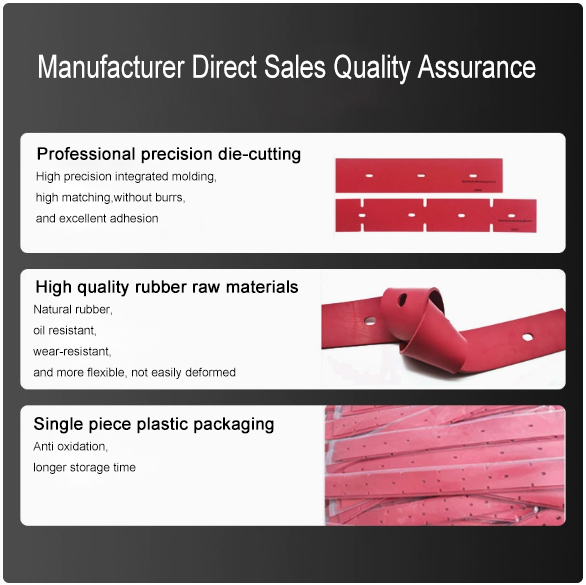
Distributors and OEMs usually arrive at custom rubber strips for one of two reasons: a machine they service is no longer supported by the OEM, or they want a house brand on a consumable they already sell in volume. Both are solvable, and neither requires the kind of tooling budget most buyers assume.
This is a practical outline of what we can vary on a squeegee blade, what it costs, and how long it takes.
What “custom” covers
| Variable | Range / options |
|---|---|
| Length | 150–2,000 mm |
| Thickness | 3–20 mm |
| Maximum width | 120 mm |
| Slot type | Straight slot, angled slot, round hole, oval/waisted hole, no hole, special profile to drawing |
| Hardness | Roughly 45–95 Shore A, selected by floor |
| Material | Natural rubber (NR-65), cast polyurethane (PU-85), gum rubber (GR-45) |
| Branding | Private label, custom printed cartons |
Standard tolerances on a production run are length ±1.0 mm, thickness ±0.2 mm, hole pitch ±0.5 mm. If your assembly needs anything tighter, say so up front — it is a conversation about the process, not a refusal.
Three routes to a custom blade, cheapest first
1. Match an existing tool. If the profile already sits in our range, there is no tooling cost at all and the minimum is 20 sets per style. Before commissioning anything, check the cross-reference guide — 75 models across 17 brands are already covered, and a surprising number of “custom” requests turn out to be a standard part under a different OEM code.
2. Cut or punch to a new pattern. Different slot layout or hole pitch on a known profile is usually a tooling modification rather than a new mould. This is the most common route and the fastest.
3. Build a new profile. A genuinely new section, length or compound goes to a new mould: USD 60–120 per style, waived once that style reaches 500 sets. Run the arithmetic — that is USD 0.12–0.24 per set at the waiver point, under one percent of landed cost. Against an industry benchmark of USD 400–5,500 in tooling with MOQs of 100–1,000 pieces, this is why small distributors can now carry their own branded blade.
The reason it is cheap — and why you should ask
A low mould number deserves a question: what is being cut to get there? In our case it is a combination of in-house tooling rather than outsourced tooling, simpler mould construction because the dominant process is extrusion plus punching, and a deliberate decision not to make money on tooling — we make it on repeat orders. If a supplier cannot answer this question cleanly, treat the cheap tooling as a warning rather than a bargain.
Choosing the compound for a custom run
| Grade | Hardness | Specify when |
|---|---|---|
| NR-65 red natural rubber | 65 ± 5 Shore A | Tile, PVC, epoxy. Linatex-class abrasion resistance. Avoid oil. |
| PU-85 cast polyurethane | 85 ± 5 Shore A | Rough concrete, grease, aggressive detergents |
| GR-45 gum rubber | 45 ± 5 Shore A | Smooth tile, light duty, price-led work |
One correction we make repeatedly: red rubber is not automatically Linatex. Red is pigment. What matters is measured abrasion loss, tensile strength and rebound — ask for batch figures rather than a datasheet. And on hardness, harder is not better: 50–75 Shore A for smooth floors, 85–95 Shore A for rough or oily ones. Too soft folds under vacuum, too hard skips over texture. The full material argument is in our squeegee blade material comparison.
Samples, timing and what to expect
Samples are charged, not free, and take 7–15 days. That is deliberate — a real sample is produced to your specification rather than pulled from stock, and free overnight samples usually mean “whatever we have on the shelf”. After approval, production scheduling follows; ask for the current lead time when you request the quote, because it moves with the season.
Order structure
- Existing profile: 20 sets per style, no tooling
- New profile: 20 sets per style, USD 60–120 tooling, waived at 500 sets
- Mixed styles in one order: allowed, USD 3,000 minimum order value
- Private label and custom cartons: available
Quality and claims on a custom run
Custom work carries a specific risk — the first article is the only proof the drawing was read correctly — so the terms matter more here, not less. Ours: claims within 7 days of receipt; manufacturing defects covered, including dimensions outside tolerance, damaged edges, flash, and hardness outside the agreed range; only the defective pieces replaced; freight on the buyer, in practice shipped with your next order; and an unboxing video as proof. Dry-fit the first article onto a scrap frame before you release the rest of the batch to customers.
Frequently Asked Questions
Who owns the mould?
The mould belongs to the customer. We hold and maintain it at no charge, and repeat orders are not charged tooling again.
Can you work from a worn sample rather than a drawing?
Yes — send the sample. Measuring a worn part has limits, so we will confirm the critical dimensions with you before cutting tooling.
What if my machine is a one-off?
It is still worth quoting. Twenty sets is a low enough entry point that single-fleet accounts are viable.
Is there a warranty on custom blades?
No warranty language — a specific replacement policy instead, with the terms above.
Start from a sample or a drawing
Send either one, plus the machine model and the floor type your customers run, and we will confirm what we can build, recommend a compound, and quote tooling and unit price within one business day.