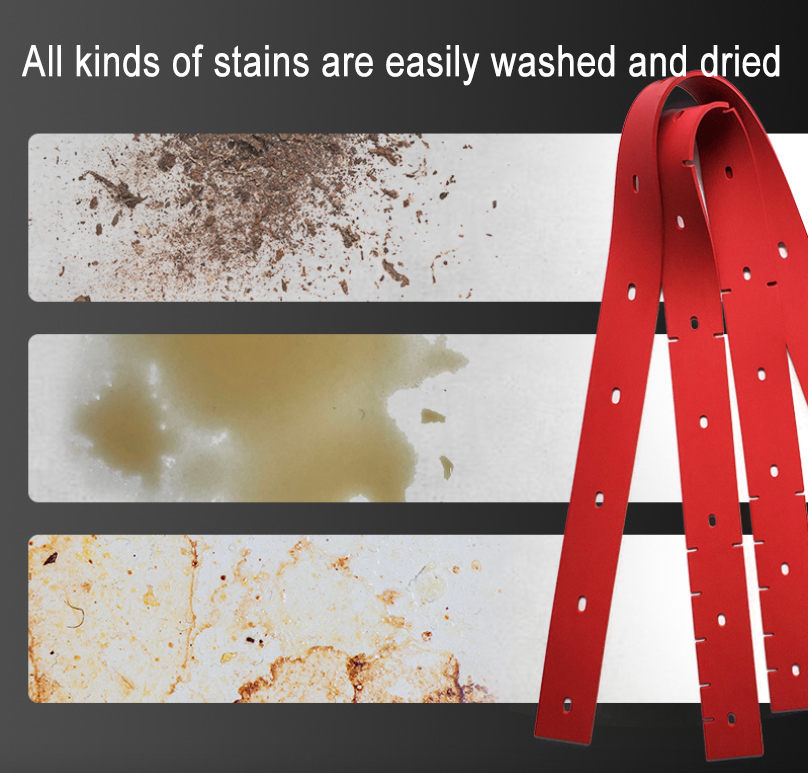
For distributors, service companies and OEM buyers, importing wear-resistant rubber strips is a straightforward way to cut the cost of a part that reorders all year. The pitch is simple: a strip that lasts longer gets replaced less often, which costs less per month and generates fewer complaints.
The pitch is also where most buyers get burned, because “wear-resistant” is a marketing word, not a specification. This is what the advantage actually consists of, how to verify it, and where the real commercial benefit sits.
What “wear resistant” should mean
A squeegee blade fails in three distinct ways, and resistance to each is a different property:
| Failure mode | What it looks like | Property that resists it |
|---|---|---|
| Abrasion | Edge gradually wears smooth and thin | Abrasion resistance (DIN abrasion loss) |
| Tearing and cutting | Edge chips, gouges, splits | Tear strength and tensile strength |
| Chemical attack | Blade swells, softens, goes wavy | Chemical resistance — this is a material choice, not a grade |
A supplier who says “wear resistant” without saying which one is selling a phrase. Ask which failure the compound is built against, because a strip optimised for abrasion will not necessarily survive a chipped-concrete floor, and no amount of abrasion resistance will save natural rubber from oil.
The three grades that cover the work
| Grade | Material | Hardness | Positioned for |
|---|---|---|---|
| NR-65 | Natural rubber, red | 65 ± 5 Shore A | Tile, PVC, epoxy; general commercial. Linatex-class abrasion performance. |
| PU-85 | Cast polyurethane | 85 ± 5 Shore A | Rough concrete, oil, grease, aggressive detergents |
| GR-45 | Gum rubber | 45 ± 5 Shore A | Smooth tile, light duty, price-led work |
In abrasive duty, polyurethane typically delivers roughly three to five times the service life of standard rubber — an industry benchmark rather than a guarantee, and one you should test rather than accept. Against that, polyurethane is harder, so it conforms less on very smooth floors, and it is more sensitive to temperature and operating conditions than natural rubber.
Two corrections we make repeatedly. Red rubber is not automatically Linatex — red is pigment, and the honest claim is measured performance. And harder is not better: roughly 50–75 Shore A for smooth floors, 85–95 Shore A for rough or oily ones. Too soft folds under vacuum; too hard skips over texture. Our material comparison sets out the full selection logic.
How to verify the claim before you import
This is the part that separates a good sourcing decision from a cheap one:
- Ask for three numbers, per batch — DIN abrasion loss, tensile strength, rebound resilience. Then ask whether they are measured on production batches or copied from a generic datasheet.
- Ask about reclaimed material directly. Batch hardness and density records are the practical proof.
- Ask for the tolerances actually held. Ours: length ±1.0 mm, thickness ±0.2 mm, hole pitch ±0.5 mm.
- Order a charged sample and measure it. Free overnight samples usually mean stock, not specification. Ours take 7–15 days because they are made to your order.
- Dry-fit the first article onto a scrap frame before releasing the batch.
A factory that measures per batch can show you the record. A factory that cannot will send you a PDF. That difference is worth more than any headline number.
Where the actual saving comes from
Not from the unit price. The saving comes from three places:
Fewer change-outs. In normal commercial use a blade runs roughly two to three months — a typical industry figure, not a guarantee. Moving that to four or five months on a difficult floor removes one or two change-outs per machine per year, and each change-out is labour plus downtime.
Fewer complaints. A blade that stops sealing leaves wet floors — a slip hazard and, in food, healthcare and retail, a compliance problem. The cost of one incident dwarfs the cost of every blade on the machine.
Lower cost per month. Price per blade divided by months of service is the only number that ranks two quotes properly. A cheap blade that lasts five weeks loses to a better one that lasts twelve. Our replacement cycle guide shows how to build that into a reorder calendar.
Commercial terms that make importing viable
- MOQ 20 sets per style for models already in our tool range — one set being one front blade plus one rear blade, so 20 sets is 40 pieces
- USD 60–120 per style tooling for a new profile, waived at 500 sets — roughly USD 0.12–0.24 per set at that point, which is why developing your own branded strip is no longer a capital decision
- Mixed orders allowed, USD 3,000 minimum order value, so one shipment can cover ten or twelve models
- Private label and custom cartons available
That structure suits how importers actually buy: a first order sized for breadth across the fleet, then concentration on whatever reorders. If you are weighing this against staying with OEM parts, the arithmetic is in OEM vs aftermarket squeegee blades, and the 75 models we already tool are listed in the cross-reference guide.
What happens if something is wrong
Get it in writing before payment: claims raised within 7 days of receipt — receipt, not despatch, not port arrival; manufacturing defects covered, including damaged edges, flash, wrong dimensions and hardness outside the agreed range; only the defective pieces replaced rather than the whole shipment; freight on the buyer, which most importers handle by consolidating replacements into the next order; and an unboxing video so a claim raised three weeks later is still factual.
Note the clock. On a long freight lane it is easy for the window to close before anyone opens a carton. Build the inspection into goods-in.
Frequently Asked Questions
Is “wear resistant” the same as “long lasting”?
No. Abrasion resistance, tear resistance and chemical resistance are different properties. Ask which failure mode the compound addresses.
How much longer does polyurethane last?
Roughly three to five times standard rubber in abrasive duty, as an industry benchmark. Test it on your own floor rather than taking the number on faith.
What is the minimum first order?
20 sets per style for tooled models, or a mixed order at USD 3,000 minimum value.
Do you offer a warranty?
No warranty language — a specific, executable replacement policy on the terms above.
Verify it on your own floor
Send the machine models you need and your worst floor, and we will recommend a grade, quote a 20-set trial, and tell you exactly what to measure at the end of the cycle.