Facility managers spend capital attention on the expensive parts — the vacuum motor, the batteries, the brush deck — and almost no attention on the cheapest part on the machine. That is backwards. The squeegee blade is a few dollars of rubber, and it is the only component whose condition directly changes how hard the rest of the machine has to work.
A blade that stops recovering water does not just leave wet floors. It makes the machine redo work, and redoing work is what wears machines out.
The mechanism: poor recovery costs you motor hours
Think about what happens when the squeegee stops sealing:
- Water stays on the floor instead of going into the recovery tank.
- The operator slows down, then goes over the same area a second time.
- The vacuum motor runs longer per square metre to move water it should have picked up first pass.
- The brush deck runs longer, the solution tank empties faster, and the battery drains harder.
- Floors stay damp — a slip hazard and, in food, healthcare and retail environments, a compliance problem.
None of that is a blade cost. It is motor hours, battery cycles, operator hours and detergent. Spread over a year, the difference between a blade that seals and a blade that sort-of seals is worth far more than the blade.
There is a second mechanism that is less obvious. A leaking squeegee keeps abrasive slurry in circulation. Dirty water that should have been recovered stays on the floor, gets re-brushed, and works like a grinding paste on both the floor and the brushes.
Why the blade is the part to manage, not just replace
The blade is the only part on the machine that is designed to be consumed. Everything else should last years. That makes it the natural place to put management effort: it is cheap, it is frequent, and it controls the load on everything downstream.
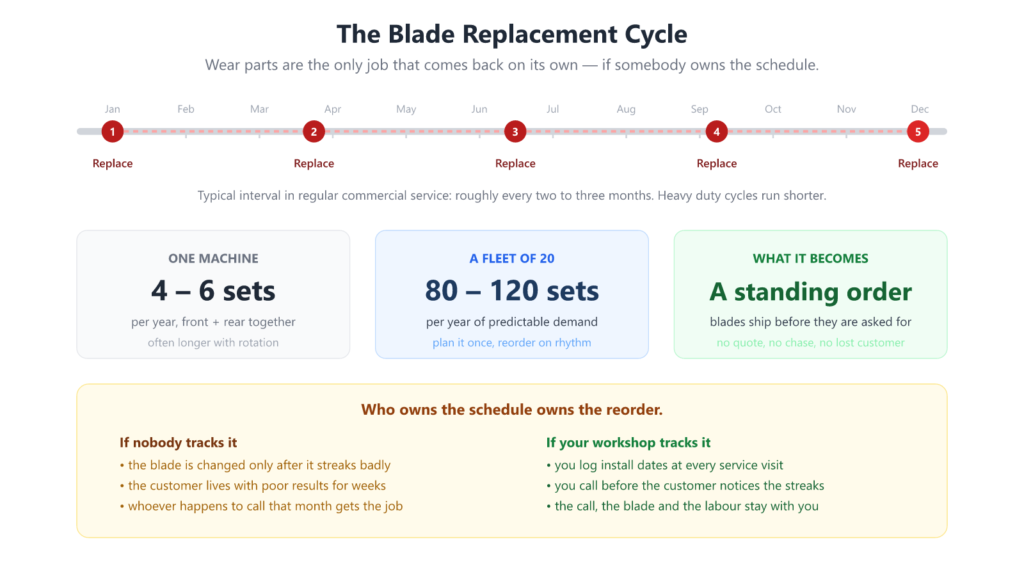
Practical target: replace on condition, inspect on a schedule. In normal commercial use a blade runs roughly two to three months — a typical industry figure, not a guarantee. Frequency, floor condition, temperature and chemicals all move it, and polyurethane grades are more sensitive to those variables than natural rubber. If your blades die in three weeks, the problem is specification or adjustment, not wear. Our blade replacement cycle guide turns this into a reorder calendar rather than a reaction.
Getting the specification right first
Most premature blade failure is a specification error, not a quality error.
| Floor and soil | Grade | Hardness |
|---|---|---|
| Smooth tile, PVC, epoxy | Natural rubber NR-65 (red, Linatex-class) | 65 ± 5 Shore A |
| Rough concrete, oil, grease, aggressive detergents | Cast polyurethane PU-85 | 85 ± 5 Shore A |
| Smooth tile, light duty | Gum rubber GR-45 | 45 ± 5 Shore A |
Two things buyers get wrong. First, natural rubber in an oily environment — it absorbs oil, loses structural integrity, goes wavy, and stops sealing, sometimes within weeks. Second, harder is not better: too soft and vacuum pressure folds the edge under the frame; too hard and the edge rides over floor texture instead of sealing into it. Roughly, 50–75 Shore A for smooth floors and 85–95 Shore A for rough or oily ones.
And one correction worth carrying: red rubber is not automatically Linatex. Red is pigment. What matters is measured abrasion loss, tensile strength and rebound — ask for batch figures, not a colour. The full argument is in our squeegee blade material comparison.
How to replace a blade properly
The procedure is simple, and the last step is the one that is skipped.
1. Safety and preparation. Switch off, remove the key, and make sure the machine cannot roll. Lift the squeegee assembly clear of the floor.
2. Release the tension. Unload the squeegee lift or the spring/knob retention so the assembly is slack. Do not force a blade out against tension — that is how frames get bent and mountings stripped.
3. Clean the assembly. This is the step that pays for itself. Scrape off grit, string and chemical crust from the frame, the vacuum slot and the mounting faces. A blade seated on debris sits at a slight angle, and a slight angle is a leak.
4. Install the set. One set is one front blade plus one rear blade — replaced together, because the front blade dams the water and the rear blade makes the final wipe. They wear at different rates but the assembly only works as a pair. Seat the blade squarely, confirm the slot and hole pattern line up, and tighten evenly from the centre outward so the blade does not bow.
5. Final adjustment. Set height and tilt so the blade just kisses the floor with a slight trailing deflection, level across the full width. Then test on a dry floor with clean water: you want an even, quiet wipe and a dry trail behind the machine. Streaks on one side mean that side is out of level — adjust the assembly, not the blade.
If your model is unclear, the cross-reference guide covers 75 models across 17 brands.
What this costs
Less than most buyers assume, and the structure rewards trying before committing:
- 20 sets per style for models already in our tool range — no tooling
- USD 60–120 per style tooling for a new profile, waived at 500 sets — roughly USD 0.12–0.24 per set at that point
- Mixed orders allowed, USD 3,000 minimum order value, so one order can cover a mixed fleet
- Samples charged, 7–15 days, made to your specification rather than pulled from a shelf
Twenty sets is small enough to trial a grade on your worst floor for one full cycle, which is the only reliable way to settle a material argument.
What to check when the cartons arrive
- Dry-fit one blade onto a scrap frame before releasing the batch
- Length ±1.0 mm, thickness ±0.2 mm, hole pitch ±0.5 mm
- Wiping edge free of nicks, flash or waviness
- Spot-check durometer with a handheld gauge
If something is wrong: claims within 7 days of receipt; manufacturing defects covered — damaged edges, flash, wrong dimensions, hardness outside the agreed range; only the defective pieces replaced; freight on the buyer, usually consolidated into the next order; unboxing video as proof.
Frequently Asked Questions
How long should a blade last?
Roughly two to three months in normal commercial use. Treat it as an industry figure, not a guarantee.
Should I use polyurethane everywhere?
No. It is the right choice for rough, oily or chemically aggressive sites, and the wrong choice for polished smooth floors where a stiff edge skips.
Can I rotate blades to get more life?
Where the profile allows it, yes — using both edges is free additional service life.
Do you cover my machine?
Probably. Check the cross-reference guide, or send a sample and we will build to it.
Start with the cheapest part
Send the machine model, the floor type and what is currently failing, and we will confirm fitment, recommend a grade, and quote within one business day.