Aftermarket replacement part — not a genuine OEM part. The squeegee blades and rubber parts on this page are aftermarket replacements made to fit Tennant machines. They are not genuine Tennant parts, we are not affiliated with or endorsed by Tennant, and brand names, model names and part numbers are used for fitment reference only. Confirm dimensions against your own sample or drawing before ordering.
Ask three suppliers for “a squeegee blade price for a Tennant T300” and you will get three numbers that cannot be compared, because each one quietly assumed a different compound, a different quantity and a different shipping term.
The price is not the problem. The request is. A blade enquiry that carries six specific fields gets a quote you can actually put next to another quote — and it gets one on the first reply instead of the fourth.
This is what those six fields are, and why each one changes the number.
1. Machine model, plus a photo of the frame
Model alone is usually not enough. Squeegee assemblies get revised within a model’s production life, and aftermarket frames fitted by a previous supplier may not match the book at all. Two photos settle it in a minute: one of the squeegee assembly in place, and one of the worn blade lying flat next to a tape measure or a ruler.
If you have the worn blade, send it. Measuring a physical part beats reading a catalogue, and it removes the single most common failure — a blade that looks right and will not bolt on.
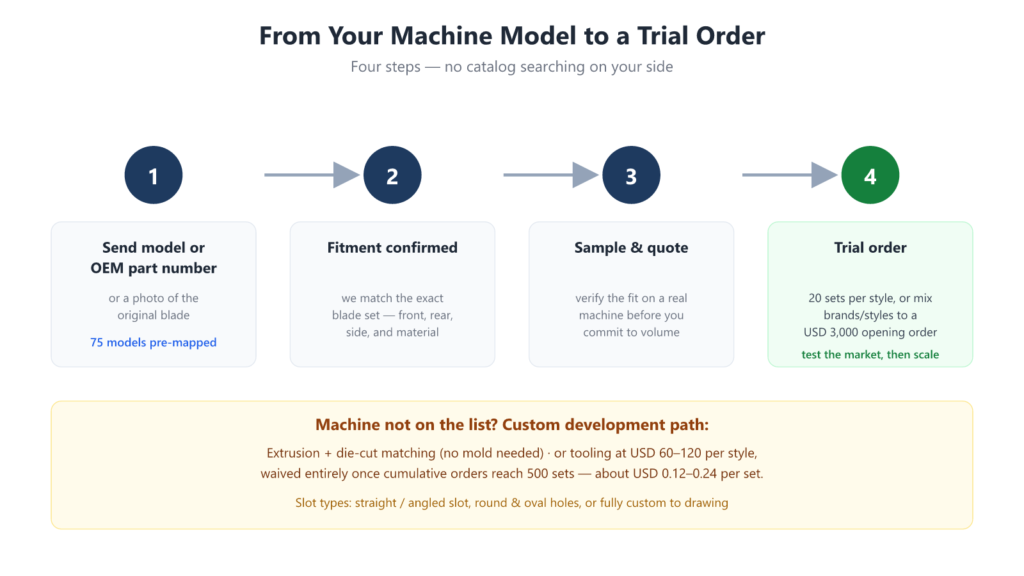
Our cross-reference guide lists the 75 models across 17 brands we already hold tooling for. If your model is on it, say so and the enquiry starts as a stock item rather than a development project.
2. Front or rear — and in what ratio
One set is one front blade plus one rear blade. They are not interchangeable and they do not wear at the same rate. The rear blade does the water pickup under vacuum and sets the replacement interval; the front blade takes the abrasion and looks worse while still working.
Ordering “blades” without saying which, or assuming a one-to-one split, is where most wrong shipments start. If your fleet consumes rear blades faster, state the ratio you want — it can be quoted that way.
3. Floor type and what is actually on it
This is the field that decides the compound, and it is the one most enquiries leave out.
| Floor and soil | Suits | Why |
|---|---|---|
| Smooth tile, PVC, epoxy | Natural rubber, 65 ± 5 Shore A | Conforms well to flat floors, cleanest pickup |
| Rough concrete, joints, oily film | Cast polyurethane, 85 ± 5 Shore A | Cut and tear resistance is the whole point |
| Light duty, smooth, price-led | Economy gum rubber, 45 ± 5 Shore A | Adequate where duty is genuinely light |
“A warehouse” is not a floor description. “Sealed concrete, forklift traffic, occasional oil mist, cleaned nightly” is. The trade-offs behind that table are set out in full in our material comparison, including where each grade stops making sense — on polished tile a harder blade chatters and streaks, and more down-pressure will not fix it.
4. Hardness as a range, with a test method
Write hardness as a range with a tolerance, not a single number: 65 ± 5 Shore A, measured by ASTM D2240.
Two reasons. A single figure invites a supplier to quote whatever is cheapest near it, and you have no basis to reject a shipment that arrives at 71. And naming the method matters: hardness measured another way, or measured on a compounder’s test coupon rather than on a production piece, is not the same number. The coupon proves the mixer; the production piece proves the tool.
If you are writing a formal specification rather than an email, ASTM D2000 is the classification system used to call out rubber properties in a way a supplier cannot reinterpret. Most buyers do not need it for a blade enquiry, but it is the right reference the moment a spec has to survive a purchasing department.
5. Annual volume and order pattern
Volume is not a number you give to sound big. It decides three separate things: whether a profile is already tooled or has to be built, what the tooling is worth, and how the shipment should be packed.
- MOQ 20 sets per style on a profile we already tool. Twenty sets is forty blades — a field trial, not a warehouse commitment.
- USD 60–120 tooling for a profile we do not hold, waived at 500 sets cumulative.
- Mixed orders allowed, USD 3,000 minimum order value, so a first shipment can cover ten or twelve models rather than betting the whole budget on one.
Say whether this is a one-off trial or the start of a standing reorder. A supplier pricing a 20-set trial and a supplier pricing 400 sets a year are doing different arithmetic, and only one of them is pricing the relationship you actually want.
6. Commercial terms, including what happens if it is wrong
Four lines close the gaps that otherwise surface after payment:
- Incoterm and destination port — a price quoted without one is not a price.
- Packaging and labelling — plain cartons, your own label, or packed per machine model for onward distribution.
- Sample policy — samples are chargeable, not free, and take 7–15 days to prepare and ship.
- Claim process — claims raised within 7 days of receipt counted from delivery, only the defective pieces replaced, an unboxing video required, freight on replacement pieces on the buyer.
That last one looks like small print until the day it is not. Coverage is for manufacturing defects — damaged or feathered edges, wrong dimensions, defective material, hardness outside the agreed range. It does not cover ordinary wear, fitting damage, or early wear from specifying the wrong compound for the floor.
The enquiry, assembled
Machine: Tennant T300, photos of frame and worn blade attached.
Requirement: rear blades, ratio 2 rear per 1 front.
Floor: sealed concrete, forklift traffic, light oil mist, cleaned nightly.
Spec: natural rubber 65 ± 5 Shore A, ASTM D2240, measured on production pieces.
Volume: 20 sets trial, ~120 sets/year if approved.
Terms: FOB, own label, samples chargeable, 7-day claim window.
Six lines. That is the difference between a quote you can compare and a number you have to re-ask for.
Service life under normal commercial duty is typically two to three months per blade — an industry figure rather than a guarantee, and one that moves with cleaning frequency, chemicals, temperature and floor condition. Polyurethane usually gives the longest interval on rough or oily floors, but it is also more sensitive to temperature and operating conditions than natural rubber, so it should be bought with that caveat attached rather than as a flat upgrade.