
If you buy squeegee blades long enough, you hit the same two names: Linatex and Linard HD. They come from the same product family, they are both natural-rubber-based, and suppliers use the names loosely enough that a lot of buyers assume they are interchangeable. They are not — they are aimed at two different failure modes.
Here is the practical distinction, and then the more important point: what to buy instead of a name.
Where Linatex came from
Linatex rubber is a high-wear-resistance natural rubber developed by the British Linatex company in the 1920s. Its reputation rests on a specific production approach — a natural rubber base compounded to deliver very high abrasion and corrosion resistance while retaining the elasticity that makes rubber useful as a wiping edge in the first place.
That combination is the reason it became the reference material for squeegee blades: an abrasive-wearing surface that still conforms to a floor. Most “wear-resistant” materials give you one or the other.
Where Linard HD sits
Linard HD is the harder, higher-tear-resistance member of that family. The design problem it solves is different. Linatex is specified when the blade dies by abrasion — the edge gradually wearing away against a rough or high-traffic floor. Linard HD is specified when the blade dies by tearing and cutting — debris, sharp aggregate, expansion joints, or a floor that chips the edge rather than sanding it.
| Linatex | Linard HD | |
|---|---|---|
| Base | Natural rubber | Natural rubber, harder compound |
| Optimised for | Abrasion resistance | Tear and cut resistance |
| Typical failure it prevents | Edge wearing away | Edge chipping, tearing, gouging |
| Trade-off | Less resistant to cutting | Higher hardness can reduce conformability on very smooth floors |
Read that last row carefully. The trade-off is real: raising tear resistance generally means a harder compound, and a harder compound conforms less. On polished tile, the softer high-abrasion grade usually seals better. On damaged concrete, the harder grade survives longer. The choice is a floor decision, not a quality decision.
The thing nobody says out loud
You are rarely choosing between genuine Linatex and genuine Linard HD. You are choosing between blades whose suppliers use those names. Which means the useful question is not “which name” but “which measured performance”.
Three numbers, asked for per production batch:
- DIN abrasion loss — how fast the edge wears
- Tensile strength — resistance to pulling apart
- Rebound resilience — whether the edge recovers after deflection
Then one correction worth internalising: red rubber is not Linatex. Red is pigment. A red blade can be an excellent abrasion-resistant natural rubber, or it can be a generic compound with a colourant. The colour tells you nothing; the DIN figure does.
How we position our own grades
We do not sell “Linatex”. We sell a measured specification:
| Our grade | Material | Hardness | Positioned for |
|---|---|---|---|
| NR-65 | Natural rubber, red | 65 ± 5 Shore A | The Linatex-class slot: abrasion resistance on tile, PVC and epoxy |
| PU-85 | Cast polyurethane | 85 ± 5 Shore A | Oil, grease, aggressive detergents, rough concrete |
| GR-45 | Gum rubber | 45 ± 5 Shore A | Smooth tile, light duty, price-led work |
If the blade in front of you is dying by abrasion on smooth commercial flooring, NR-65 is the natural comparison. If it is dying by tearing on damaged concrete, the conversation is about a harder compound — and if there is oil in the picture, neither natural-rubber answer is right and you want PU-85 instead. The full comparison, including hardness selection by floor, is in our squeegee blade material comparison.
Hardness, briefly
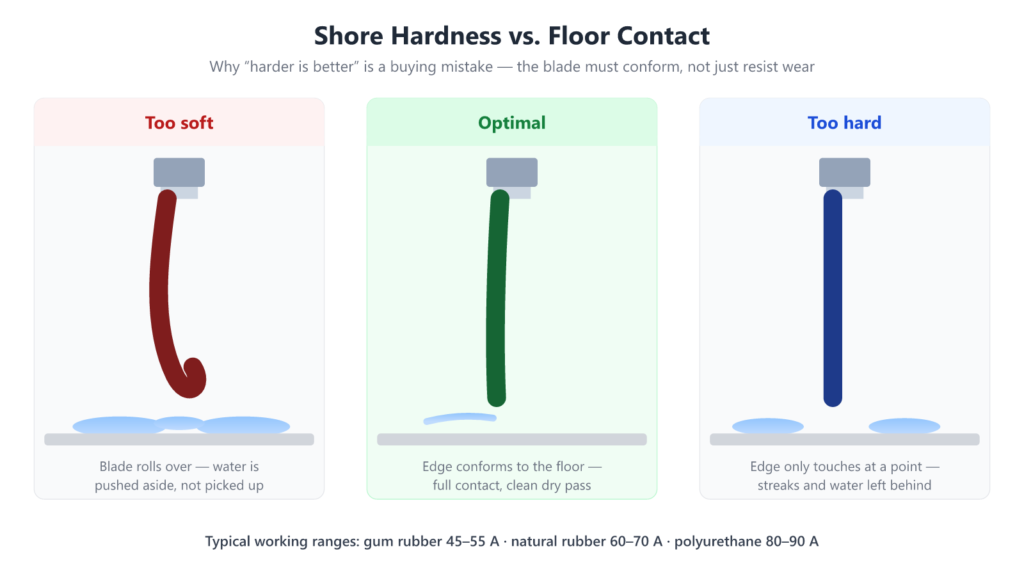
Treat durometer as a fitment setting: 50–75 Shore A for smooth floors, 85–95 Shore A for rough or oily floors. Too soft and vacuum pressure folds the edge under the frame and it leaks. Too hard and the edge rides over floor texture instead of sealing into it. Both symptoms get reported as “the blade is worn”.
Service life and how to test the claim
In normal commercial use, expect roughly two to three months per blade — a typical industry figure, not a guarantee. Cleaning frequency, floor condition, temperature and chemicals all move that number, and polyurethane grades are more sensitive to those variables than natural rubber.
The cheapest way to settle a material argument is a trial rather than a datasheet: 20 sets per style for models we already tool, run them on your worst floor for one full cycle, and measure what comes off. Mixed orders are allowed at a USD 3,000 minimum order value, so a trial can span several models. New profiles carry USD 60–120 in tooling, waived at 500 sets.
Frequently Asked Questions
Is Linard HD better than Linatex?
Not universally. It is better against tearing and cutting; Linatex-class compounds are better against pure abrasion and conform better on smooth floors.
Is red rubber the same as Linatex?
No. Red is pigment. Ask for measured abrasion, tensile and rebound figures per batch.
Which should I stock?
For a mixed fleet: an abrasion-grade natural rubber for commercial tile and epoxy, and a polyurethane grade for rough or oily sites. Coverage matters more than the badge — see the cross-reference guide for the 75 models we tool.
What are your defect terms?
Claims within 7 days of receipt; manufacturing defects covered; only the defective pieces replaced; buyer covers freight, usually consolidated into the next order; unboxing video as proof.
Get a specification, not a name
Tell us the floor and how the current blade is failing — worn smooth, or chipped and torn — and we will recommend the grade and quote within one business day.

One Response