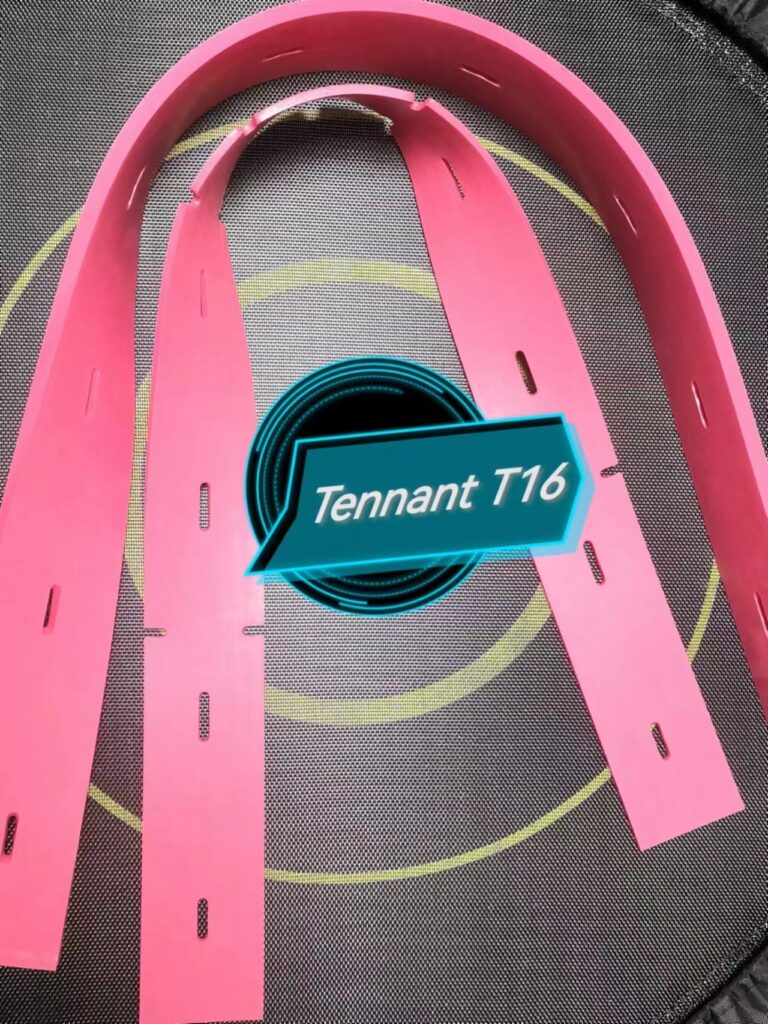
The Tennant T16 sits at the heavy end of the ride-on scrubber range, and fleet buyers who treat it like a mid-size rider end up reordering. Bigger machine, wider squeegee assembly, more down-pressure, longer shifts. Every one of those pushes the blade harder, and the failure modes show up as wet floors rather than as broken rubber.
This page is written for distributors and facility buying groups sourcing T16 replacement blades in quantity. It covers what to confirm before you order, how to specify the compound, and the commercial terms that actually apply.
Start with the set, not the blade
One set is one front blade plus one rear blade. That sounds trivial and it is the most common cause of a wrong shipment. On a large ride-on the two do different jobs and wear for different reasons:
- The rear blade holds the vacuum seal across the full width. It decides whether the floor dries.
- The front blade takes the debris load and most of the abrasion, and it is the piece that usually looks worn first.
Two consequences. Order “blades” without naming front or rear and you will get half a fleet’s worth of the wrong half. And because a T16 assembly is wide, the cost of shipping the wrong profile back is not a rounding error — it is the reason we ask for a sample or a frame photo before cutting anything.
Our cross-reference guide lists the models and brands we already hold tooling for. If the assemblies on your units have been revised or replaced with an aftermarket frame, treat that as a new profile rather than assuming it matches the catalogue.
The three checks that prevent comebacks
| Check | What to confirm | What goes wrong if you skip it |
|---|---|---|
| Profile, radius and thickness | Seats along the whole curve with no lift at the ends | Ends lift and leave two wet trails behind the machine |
| Hole pitch and slot layout | Matches the worn blade or the frame drawing | Looks identical in a photo and will not bolt on |
| Durometer | Agreed range with ±5 Shore A tolerance, measured on production pieces | Too hard skips over floor texture; too soft folds under vacuum |
Hardness is measured by the ASTM D2240 durometer method, and batch-to-batch compound classification is framed by ASTM D2000. Naming both when you request quotes is worth the two lines it costs. A supplier quoting a bare “65 Shore A” with no test method, or promising a tolerance tighter than ±5 Shore A, is promising something a production batch will not hold. Ask for readings taken off production pieces, not off a compounder’s test coupon — the coupon proves the mixer, the production piece proves the tool.
On exact length, slot positions and thickness for your specific T16 build, we work from a sample or a drawing rather than a generic chart. Frame revisions vary between production runs and between regions. Send the worn blade or a clear photo of the frame and we will confirm before shipping or before cutting tooling. Anything we cannot confirm, we say so instead of guessing.
Grade follows the floor, not the machine
The T16 does not have a “correct” blade material. The floor does.
- Natural rubber, 65 ± 5 Shore A — smooth tile, PVC, epoxy. Conforms well to flat floors and gives the cleanest pickup. The default for most indoor commercial work.
- Cast polyurethane, 85 ± 5 Shore A — rough or damaged concrete, expansion joints, oily and greasy surfaces. On a big ride-on running long shifts over abrasive floors, this is usually the grade that pays for itself on labour saved alone.
- Economy gum rubber, 45 ± 5 Shore A — light duty on smooth floors where the decision is price-led and the area is small.
The trade-off in full, including where each grade stops making sense, is set out in our material comparison. Two mistakes are worth flagging because they are expensive. The first is assuming harder is always better: on polished tile a hard blade chatters and streaks, and adding down-pressure makes it worse, not better. The second is assuming red means premium — red is pigment, performance is formulation.
Service life in normal commercial duty is typically two to three months per blade, an industry figure rather than a guarantee. It moves with cleaning frequency, chemicals, temperature and floor condition. A T16 running daily across a large site will sit at the short end of that range, which is an argument for planning replacement rather than reacting to it; our replacement cycle guide goes into the scheduling side. Polyurethane generally gives the longest interval on rough or oily floors, but it is more sensitive to temperature and operating conditions than natural rubber, so it should be sold with that caveat attached rather than as a flat upgrade.
The comparison that matters is cost per hour
On a machine this size, blade cost is a small line and machine downtime is a large one. A cheap blade that streaks costs a re-clean, a complaint and possibly a slip incident; the blade price is noise against that. For a distributor, the margin usually sits in the gap against a captive OEM parts channel rather than in shaving the unit price. That argument is developed in OEM vs aftermarket squeegee blades.
Our standard terms:
- MOQ 20 sets per style on a profile we already tool.
- USD 60–120 tooling for a profile we do not hold, waived once cumulative volume reaches 500 sets.
- Mixed orders allowed, USD 3,000 minimum order value, so a first container can cover a dozen models instead of betting the whole budget on one.
Settle the claim process before you pay
Blade complaints surface at goods-in, which on a long freight lane is weeks after manufacture. Agree the rules while the order is still open:
- Claims raised within 7 days of receipt, counted from delivery, not from dispatch.
- Only the defective pieces are replaced, not the whole batch.
- An unboxing video is required, filmed from before the carton opens and close enough to show the defect.
- Freight on replacement pieces is on the buyer; most importers absorb it by consolidating into the next shipment.
Coverage is for manufacturing defects: damaged or feathered edges, wrong dimensions, defective material, hardness outside the agreed range. It does not cover ordinary wear, fitting damage, or early wear caused by specifying the wrong compound for the floor.
Samples are chargeable, not free, and take 7–15 days to prepare and ship.
Getting a quote
Send us the machine model, how many units you run, your floor type and whether the assemblies are straight or curved. We will confirm the T16 profile against a sample or drawing, recommend a grade for your conditions, and quote a 20-set trial you can fit before committing to volume. Request pricing or a sample set and we will come back with lead time and freight options.