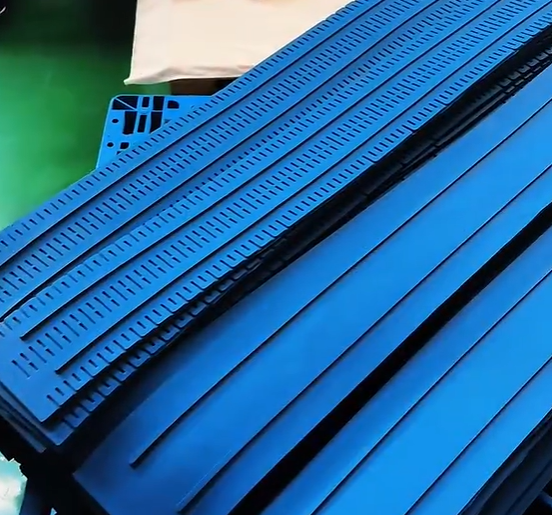
Aftermarket replacement part — not a genuine OEM part. The squeegee blades and rubber parts on this page are aftermarket replacements made to fit Kärcher machines. They are not genuine Kärcher parts, we are not affiliated with or endorsed by Kärcher, and brand names, model names and part numbers are used for fitment reference only. Confirm dimensions against your own sample or drawing before ordering.
We have finished a new tool set for the Kärcher 90/160 squeegee blade profile. For a distributor, service company or aftermarket parts brand, a new tool is not a product announcement — it is a change in what you can quote, what you can promise, and what your margin looks like on one of the most reorder-heavy parts in the catalogue.
This is what the tool actually is, what we measured before releasing it, and what it means commercially.
Why the Kärcher 90/160 profile is worth tooling
Kärcher 90/160 machines are workhorses in contract cleaning, retail and light industrial sites. Three things make the blade profile worth the investment:
- Volume. These machines run daily, and the blade is the part that wears out first. Replacement cycle data puts a commercial machine at roughly four to six sets per year.
- Fragmentation. Operators serviced by different dealers end up with different part numbers for what is physically the same profile. A correct aftermarket tool collapses that confusion into one reference.
- Margin pressure. OEM blade kits on this class of machine are priced for a captive parts channel. That gap is the entire business case for an aftermarket programme — the arithmetic is set out in OEM vs aftermarket squeegee blades.
What we built, and to what tolerance
The tool produces the front and rear blade as a matched set, because that is how the part is sold and fitted — one set equals one front blade plus one rear blade.
| Parameter | Held tolerance | Why it matters |
|---|---|---|
| Length | ±1.0 mm | Overlength buckles in the frame; short leaves a dry gap at the ends |
| Thickness | ±0.2 mm | Thickness drives how the blade seats in the channel and how it flexes |
| Hole pitch | ±0.5 mm | The single most common reason a blade that “looks right” will not bolt on |
| Hardness | ±5 Shore A | Outside this range the blade either folds under vacuum or skips over floor texture |
Those four numbers are the whole fitment argument. Most aftermarket blades that fail in the field fail on hole pitch, not on material — the material is fine, the blade simply cannot be mounted square.
We cut the first articles in both natural rubber and polyurethane. Natural rubber, 65 ± 5 Shore A for smooth tile, PVC and epoxy, and cast polyurethane, 85 ± 5 Shore A where the floor is rough concrete or carries oil and grease. The selection logic is the same one we apply across all 75 models in the cross-reference guide.
What we checked before releasing the tool
A new tool is only worth announcing once it has been fitted, not machined:
- Dry-fit onto the actual frame, not a drawing. Bolts through, no forcing, blade sits level along its length.
- Mounted-flatness check. Lay the mounted blade on a surface plate; any bow shows as an uneven wear line within days.
- Vacuum pick-up on a wet floor. The machine has to leave the floor dry at normal travel speed, on the floor type the customer actually has.
- Edge wear after a controlled run. Photograph the edge at set intervals; even wear means correct geometry, a feathered or rolled edge means wrong hardness for that floor.
- Hardness verified on production pieces, not on a test coupon from the compounder.
That last point is the one worth insisting on with any supplier. A sample machined carefully proves the machine shop. A piece pulled from a production batch proves the tool.
What it costs to develop your own profile
The economics of tooling are often assumed to be a barrier. They are not:
- USD 60–120 per style for a new profile
- Waived at 500 sets cumulative — at that point tooling has cost roughly USD 0.12–0.24 per set
- MOQ 20 sets per style once the tool exists
- Mixed orders allowed at USD 3,000 minimum order value, so a first shipment can cover ten or twelve different models rather than committing to one
That is why own-brand blade programmes are no longer a capital decision for a mid-size distributor. The question is not whether you can afford the tool; it is whether the model reorders enough to justify the shelf space.
How to qualify this blade for your catalogue
If you are adding an aftermarket line, run it in this order:
Start with 20 sets on the models your customers call about most. One set is a front plus a rear blade, so 20 sets is 40 pieces — enough for a genuine field trial across several machines.
Pick the grade by floor, not by price. A polyurethane blade on polished tile will chatter and leave streaks; a soft gum rubber blade on rough concrete will fold. Match hardness to floor first, then optimise cost. Our material comparison covers the full trade-off, including why polyurethane is more sensitive to temperature and operating conditions than natural rubber.
Measure the outcome in cost per month, not cost per blade. A blade that lasts two to three months in normal commercial service — an industry figure, not a guarantee — at a lower price beats a premium blade that lasts the same time.
Put the replacement terms in writing before you pay. Claims within 7 days of receipt, manufacturing defects covered, only the defective pieces replaced, freight on the buyer, and an unboxing video so a claim raised later is still factual. On a long freight lane the window can close before anyone opens a carton, so build inspection into goods-in.
Frequently Asked Questions
Is this a genuine Kärcher part?
No. It is an aftermarket blade built to fit the Kärcher 90/160 profile, produced on our own tooling.
What is the minimum order?
20 sets per style for tooled models, or a mixed order at USD 3,000 minimum value.
Can I get my own brand on it?
Yes — private label and custom cartons are available.
How long does a sample take?
7–15 days. Samples are charged; they are made to your order rather than pulled from stock.
What if the first batch does not fit?
Claims within 7 days of receipt on manufacturing defects, defective pieces replaced. Freight is on the buyer, which most importers handle by consolidating into the next shipment.
Get the profile drawings
Send us the machine model and your floor type, and we will confirm the profile, recommend a grade, and quote a 20-set trial you can fit before committing to volume.