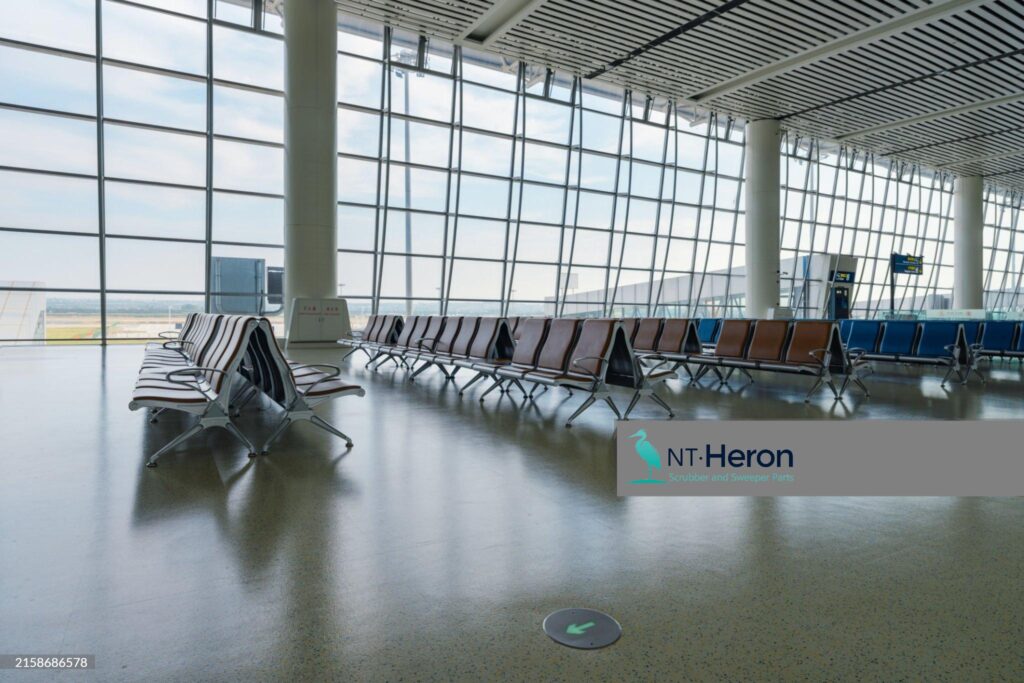
Airport terminals are the hardest environment a floor scrubber works in. Not because the dirt is unusual, but because three constraints apply at once: the floor must stay dry while it is being cleaned, the cleaning cannot stop, and a wet floor in a crowd is a liability, not an inconvenience.
That combination changes what “a good blade” means. This is what the duty actually demands, and how to specify it.
Why airports break blades faster
Four conditions, all present at once:
| Condition | What it does to the blade |
|---|---|
| Continuous operation | Machines run overnight and between waves; blades get no recovery time and wear accumulates fast |
| Very large floor area | Long runs per tank mean the blade works at the edge of its recovery capacity for hours |
| Mixed floor surfaces | Terminal floors shift between polished stone, terrazzo, epoxy and rubber matting, often within one route |
| De-icing and outdoor residues | Grit and salt carried in from apron areas act as an abrasive paste on the blade edge |
The practical result is that blade life in a terminal is typically at the short end of the normal commercial range — the industry figure of roughly two to three months assumes ordinary commercial duty. In continuous airport service, plan at the short end and verify rather than assume.
That is why blade specification in this sector is a procurement decision, not a maintenance one. Our replacement cycle guide shows how to build a reorder calendar that assumes the short end and still avoids emergency orders.
Specifying the blade: the three decisions that matter
1. Hardness, chosen per surface
Airport routes almost never have a single floor type, which is the real difficulty. The working range:
- 50–75 Shore A for smooth surfaces — polished stone, terrazzo, sealed epoxy. Softer compounds conform to the floor and hold vacuum.
- 85–95 Shore A for rough or aggressive surfaces — textured concrete, apron-adjacent areas, anywhere grit is present.
A single hardness across a mixed route is a compromise. Where routes are stable, specify per route. Where they are not, choose for the dominant surface and accept reduced life on the rest. Note that polyurethane is more sensitive to temperature and operating conditions than natural rubber — relevant in terminals with large conditioned-to-unconditioned transitions.
The full trade-off is set out in our material comparison.
2. Chemical resistance, because of what gets tracked in
De-icing salts, fuel residues and aggressive detergents attack blade compounds differently. Natural rubber swells and softens in oil; polyurethane resists it but costs more and conforms less. If any part of the route touches apron-adjacent or hangar-adjacent flooring, specify for chemical exposure first and abrasion second.
3. Tolerance, because downtime is worse than wear
On a route that runs nightly, a blade that does not bolt on square is more expensive than a blade that wears out early — one costs a technician, the other costs a part. Specify:
- Length ±1.0 mm
- Thickness ±0.2 mm
- Hole pitch ±0.5 mm
- Hardness ±5 Shore A
Hole pitch is the one that causes most field failures, and it is the one suppliers are least willing to state in writing. Ask for it by name.
Where to save money, and where not to
The temptation in high-volume sites is to buy the cheapest blade and change it more often. It works until it does not:
Save on unit price across the fleet. This is legitimate and large. The OEM vs aftermarket comparison shows where an aftermarket blade earns its place and where OEM genuinely justifies the premium.
Do not save on inspection. A blade that looks correct and is 0.8 mm out on hole pitch will not mount square. It fails on the floor, not in the box.
Do not save by over-hardening. A harder blade lasts longer on rough floors and streaks on smooth ones. In a terminal, streaking is the visible failure — passengers see it before maintenance does.
What a terminal reorder programme looks like
For a site running several machines:
- Standardise per route, not per machine. Routes have stable floor types; machines get rotated.
- Stock by wear rate, not by machine count. Measure one cycle, then set par levels from the result.
- Keep front and rear as a set. One set is one front blade plus one rear blade — replacing only the front leaves the rear to fail mid-cycle and puts the machine back on the floor twice.
- Order mixed. Multiple profiles in one shipment at USD 3,000 minimum order value, with 20 sets per style minimum on tooled models, keeps a mixed fleet covered without overstocking any single profile.
The 75 models and 17 brands we already tool are listed in the cross-reference guide. If your machines are not listed, tooling runs USD 60–120 per style, waived at 500 sets cumulative — which is why developing a profile for an uncommon machine is usually worth doing rather than working around it.
Getting the specification right before you commit
- Map the routes by floor type, not by building. One terminal can contain three surface types.
- Run a charged sample on the worst route, not the easiest. Samples take 7–15 days because they are made to order.
- Check pick-up at working speed. A blade that only seals at slow travel is not fit for a nightly route.
- Inspect the edge after one week. Even wear confirms the specification; feathering or rolling means wrong hardness.
- Agree the replacement terms in writing — claims within 7 days of receipt, manufacturing defects covered, defective pieces only, freight on the buyer, unboxing video required.
Frequently Asked Questions
How often should airport blades be changed?
Plan at the short end of the commercial range and verify on your own routes. Continuous duty and grit both shorten life.
Should we use one hardness across the whole terminal?
Only if the floor is uniform. Where routes are stable, specify per route.
Is OEM necessary for airport machines?
Rarely on blades. The case for OEM is strongest on parts where a failure has safety consequences; a blade is a wear item with a measurable replacement cycle.
Can we order several profiles in one shipment?
Yes — mixed orders at USD 3,000 minimum value, 20 sets per style on tooled models.
Specify it from your routes
Send the machine models and the floor types on each route, and we will recommend a grade per route, quote a 20-set trial, and tell you what to measure at the end of the first cycle.