A squeegee blade shipment is checked at goods-in, and that is the only moment anyone seriously looks at it. Miss it and the next few months are spent discovering problems one machine at a time, in a form nobody can claim on.
Four checks, roughly fifteen minutes on a sample carton, catch essentially everything that is worth catching. None of them need a lab.
What to have ready before the carton opens
Three things, and the third is the one people skip:
- The approved sample or the confirmed drawing — the physical reference the order was placed against.
- A tape measure and a durometer. A hand-held Shore A durometer is a few hundred dollars and pays for itself on the first disputed shipment.
- A phone set to video, filming before the carton is opened.
That last one is not busywork. Claims are raised within 7 days of receipt — counted from delivery, not dispatch — and an unboxing video is required, filmed from before the carton opens and close enough to show the defect. Without it, a defect discovered in week two is a conversation about whose fault it was rather than a replacement.
Check 1 — Count, cartons and labelling
Count cartons against the packing list first, then open one and count pieces against the carton label. Then check the labelling matches what you ordered: model, front or rear, compound.
This sounds trivial, and it is where the expensive mistakes hide. A mixed-model order packed correctly but labelled by the wrong model does not get noticed at goods-in, gets distributed to sites, and surfaces as four separate “wrong blade” complaints three weeks later from three different buildings. By then the cartons are gone and so is the evidence.
One set is one front blade plus one rear blade. If you ordered unbalanced — two rear per front, say — check the split actually matches.
Check 2 — Dimensions against the approved sample
Do not measure against a catalogue. Measure against the physical sample you approved, or against the drawing the order was confirmed on.
| What | How | Fails if |
|---|---|---|
| Length | Lay sample and production piece side by side, ends aligned | Ends do not align; dry streak at each end on the machine |
| Thickness and profile | Seat a piece in the actual channel | Rocks in the channel, or flexes instead of wiping |
| Hole pitch and slots | Offer the piece up to the frame | Will not bolt on without forcing |
The hole pitch is the classic. It is the reason a blade that looks identical will not fit, and it is routinely reported by operators as “bad rubber” when the compound is fine and the mounting never was.
The ISSA distributor side of the industry runs on planned consumable reordering precisely because checks like this are cheaper at goods-in than at the machine.
Check 3 — Hardness, spot-checked
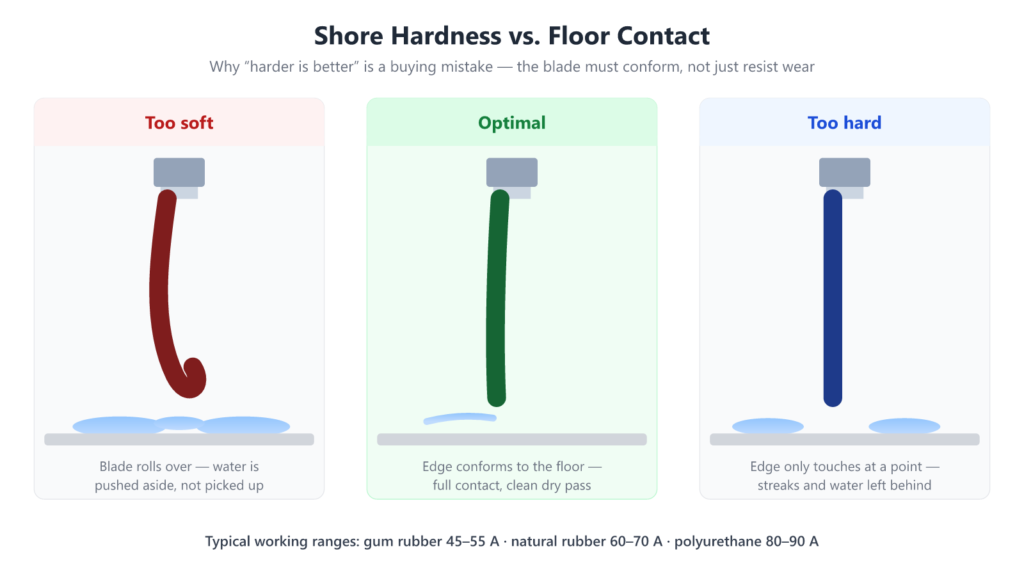
Take three pieces from three different cartons, not three from one. Press the durometer per ASTM D2240 — flat on a hard surface, several readings per piece, and record the numbers.
You ordered a range, not a figure: 65 ± 5 Shore A for natural rubber, 85 ± 5 for cast polyurethane, 45 ± 5 for economy gum rubber. Anything inside that range is to specification. Anything outside it is a manufacturing defect and is claimable.
Two cautions. Read a production piece, not a test coupon — the coupon proves the mixer was right on the day, the production piece proves the tool is. And do not reject a shipment for reading 68 when you specified 65 ± 5; ±5 is a realistic production tolerance, and a supplier who promised ±1 was never going to hold it across batches.
If you did not specify hardness as a range with a test method, this check is unavailable to you. That is an ordering problem, and it is fixed at the enquiry stage rather than at goods-in — the six fields that prevent it are set out in our material comparison.
Check 4 — Edge and surface
Run a finger along the wiping edge, then look at it against the light.
- Feathered, nicked or wavy edge — manufacturing defect, claimable.
- Visible mould flash, tears, or embedded grit in the surface — claimable.
- Flat spots or deformation from packing — usually storage or transit, photograph it and raise it anyway; it is often worse than it looks and it always gets worse in service.
Edge condition is the single best predictor of how a blade performs in its first week. A blade with a damaged edge leaves water on day one, and no amount of break-in fixes it.
If something fails
- Raise it within 7 days of receipt, with the video and photographs.
- Expect only the defective pieces to be replaced, not the whole batch. Twelve faulty out of two hundred means twelve replacements.
- Freight on replacement pieces is on the buyer; most importers absorb it by consolidating into the next shipment.
- Coverage is manufacturing defects only — damaged or feathered edges, wrong dimensions, defective material, hardness outside the agreed range. Not ordinary wear, not fitting damage, and not early wear caused by specifying the wrong compound for the floor.
Record the readings somewhere you can find them again. A durometer log per shipment, kept in a spreadsheet, is the fastest way to spot a supplier who is drifting batch to batch — and it is the difference between an argument and a claim.
Planning the next shipment
Service life in normal commercial duty is typically two to three months per blade — an industry figure rather than a guarantee, and one that moves with cleaning frequency, chemicals, temperature and floor condition. A machine in daily service goes through roughly four to six sets a year, which we break down in our replacement cycle analysis.
Buying to that cadence rather than to failure changes this check from a formality into a routine — and it means a bad batch is caught while it is still one carton in a storeroom rather than forty blades across six sites.