Aftermarket replacement parts — not genuine OEM parts. The squeegee blades and rubber parts on this page are aftermarket replacements made to fit the machines named here (Nilfisk and Tennant). They are not genuine parts from those manufacturers, we are not affiliated with or endorsed by them, and brand names, model names and part numbers are used for fitment reference only. Confirm dimensions against your own sample or drawing before ordering.
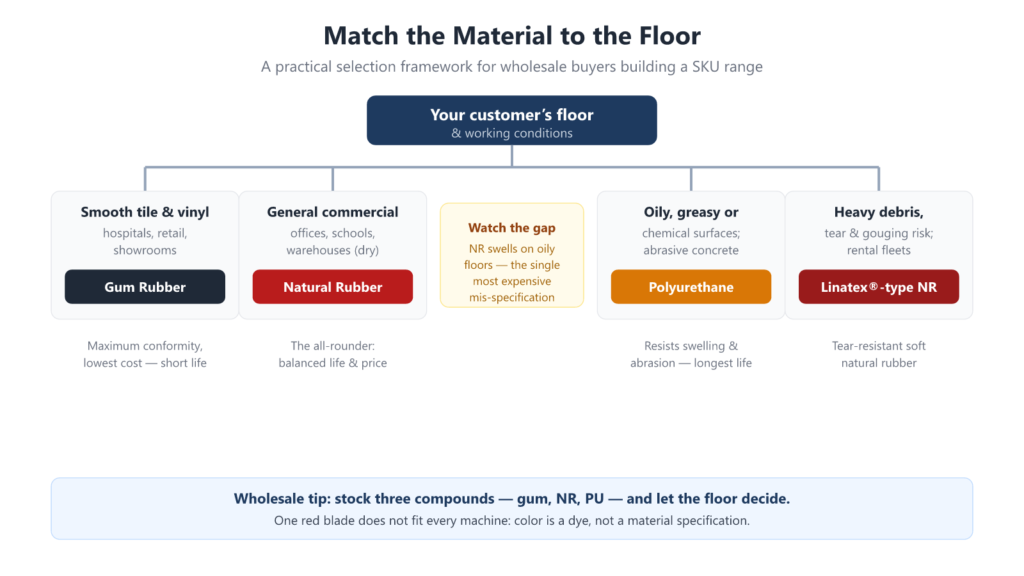
There are three material families in common use for floor scrubber squeegee blades, and buyers often ask which one is “better” as if there were a ranking. There isn’t. There is a material that matches your floor, and two that don’t. Pick the wrong one and the blade fails in weeks; pick the right one and the question stops coming up.
Here is the short version, then the reasoning.
The short answer
| If your floor is… | Use | Hardness |
|---|---|---|
| Smooth tile, PVC, terrazzo, epoxy — normal commercial cleaning | Natural rubber, NR-65 (red, Linatex-class) | 65 ± 5 Shore A |
| Rough concrete, oily or greasy, aggressive detergents | Cast polyurethane, PU-85 | 85 ± 5 Shore A |
| Smooth tile, light duty, price is the only criterion | Gum rubber, GR-45 | 45 ± 5 Shore A |
If you only remember one line: natural rubber for smooth floors, polyurethane for rough or oily floors.
Why the three behave differently
Natural rubber (NR-65) is the general commercial default because it does the thing a squeegee blade has to do — conform to a floor and hold a seal — exceptionally well. It has high rebound, so the edge recovers after deflecting over joints and grout lines, and strong abrasion resistance on smooth surfaces. Its weakness is oil: natural rubber absorbs it, loses structural integrity, goes wavy, and stops sealing. In a food plant or a machine shop, this is the wrong material regardless of how good the compound is.
Cast polyurethane (PU-85) is the chemical and oil specialist. It resists grease, oil and aggressive detergents far better than natural rubber, and on rough concrete it outlasts it substantially. The trade-offs are real: it is harder, so it conforms less on very smooth floors — a stiff edge can skip over texture instead of sealing into it — and it is more sensitive to temperature and operating conditions than natural rubber. Polyurethane is the right answer for a difficult floor, not an automatic upgrade.
Gum rubber (GR-45) is the economy option. Soft, cheap, fine on smooth tile at low hours. It abrades quickly and is not a candidate for abrasive or oily floors.
Hardness is the setting people forget
Durometer is a fitment variable, not a quality grade. Working rule:
- 50–75 Shore A — smooth floors. Softer edges seal better.
- 85–95 Shore A — rough or oily floors. Harder edges resist cutting and tearing.
Too soft and the vacuum pulls the edge under the frame, and the machine leaks. Too hard and the edge rides over the floor texture. Both get reported by operators as “the blade is worn out”, which is why the fix is often a hardness change rather than a new supplier.
One correction worth making early
Red rubber is not automatically Linatex. Red is pigment. Linatex is a specific abrasion-resistant natural rubber formulation. Plenty of red blades share nothing with it beyond the colour. If a supplier sells you the colour, ask for the three numbers that actually predict life — DIN abrasion loss, tensile strength and rebound resilience — and ask whether they are measured on your production batch or copied from a generic datasheet.
Front and rear are not the same blade
A squeegee assembly works as a system: the front blade dams and slows the water, the vacuum slot behind it extracts, and the rear blade makes the final wipe. They wear at different rates but are replaced together, which is why the trade unit is 1 set = one front blade + one rear blade — so a 20-set order is 40 pieces. On some platforms (Tennant T7, T12, T16, T20; Nilfisk BR855) there are additional side blades, sold separately. If a machine is leaving a trail, check the rear edge first.
For the full material argument, including how hardness interacts with floor texture, see our squeegee blade material comparison.
How long should the right blade last?
In normal commercial use, roughly two to three months. Treat that as a typical industry figure, not a guarantee — cleaning frequency, floor condition, temperature and chemicals all move it, and polyurethane grades are more sensitive to those variables than natural rubber. Where the profile allows it, rotating the blade to use both edges is free additional life. If you want to turn that into a reorder schedule, see the blade replacement cycle guide.
What it costs to find out
Less than most buyers expect:
- 20 sets per style for models already in our tool range — no tooling
- USD 60–120 per style tooling for a new profile, waived at 500 sets (roughly USD 0.12–0.24 per set at that point)
- Mixed orders allowed, USD 3,000 minimum order value, so one order can cover several models
- Samples charged, 7–15 days, made to your specification rather than pulled from stock
Twenty sets on your worst floor for one full cycle will answer the material question better than any datasheet. If you also need to confirm what fits, the cross-reference guide lists 75 models across 17 brands.
Frequently Asked Questions
Which blade lasts longest?
On rough or oily floors, polyurethane. On smooth commercial floors, a good abrasion-grade natural rubber. There is no single winner because the answer is a floor, not a material.
Is harder better?
No. Harder resists cutting but seals worse on smooth floors. Match hardness to floor texture.
Can I put my own brand on it?
Yes — private label and custom cartons are available.
What if the blade is wrong?
Claims within 7 days of receipt; manufacturing defects covered; only the defective pieces replaced; freight on the buyer, usually consolidated into the next order; unboxing video as proof.
Get the right grade first time
Send the machine model and the floor type — and whether there is oil or aggressive detergent in the process — and we will recommend the grade and quote within one business day.